|
RenewingMinds
|

The Journal
Below is eclectic and candid commentary, as well as information bulletins of site additions for 2005. Kind thanks to my dear wife for proof reading these comments from time-to-time. Most recent posts are shown first:
January through June 2005 is published as a separate page due to the large file sizes for this year.
12/31/2005
The study of the book of ACTS is probably one of the most difficult, due to its largely historic and theologically-transitional nature. Among sovereign grace dispensationalists, it seems to form a 'watershed' for interpretation. We hold to the view that the Body of Christ, the Church, began with the descent of the promised Holy Spirit on the Jewish Feast of Pentecost (Acts 2). A number of dispensational visitors to withChrist.org, who hold to post-Acts 2 views and are unfamiliar with classic Pauline dispensationalism, often scratch their head in amazement.
To help visitors gain an interpretational perspective, I've put together a five part overview of the book of ACTS using works by Huebner and Stanford. I hope this will help students in their biblical understanding of this critic time in the history of the Church.
See: ACTS - The History of the Spirit's Work in Testimony to the Resurrection and Glorification of Christ
Read the recent email comments that prompted the above.
12/29/2005
The term "disciple" means a learner. Except for the prophetic reference in Isaiah 8:16, the Greek word, mathetes, is found exclusively in Matthew, Mark, Luke, John, and Acts. Acts 11:25, 26 states:
"And when he [Barnabas] had found him [Paul], he brought him to Antioch. So it was that for a whole year they assembled with the church and taught a great many people. And the disciples were first called Christians in Antioch."
Based on other historical events, scholars are able to date the Apostle Paul's arrival in Antioch in the summer of A.D. 43. The authorship of Paul's first epistle ranges from 5 to 8 years later--A.D. 48-51. Nowhere in any of his Epistles does Paul use the term disciple or discipleship. In fact, Acts 21:16 is the final use of the term disciple for any NT author. Thereafter, the terms: "Christian", "believer", "brother," and "saint" are frequently used for members of the heavenly Body of Christ.
Unless we're talking about the earthly followers of Jesus of Nazareth or specific individuals mentioned in Acts, we should seek to avoid using either the term disciple or discipleship when speaking of Christian believers. Our position is heavenly!
12/28/2005
A large percentage of visitors to withChrist.org, those who spend time reading and studying biblical truth along with the Word, are not charismatic-types with their 'hair on fire'. Our approach is typically far too mundane for these folks, with few exceptions. Today a frantic husband, upon finding the Neil Anderson articles written by MJS, wrongly assumed that he was on Anderson's website (I guess he didn't take the time to read), and typed out his plea for "Help!" Most of our readers seldom get the opportunity to witness the pathetic plight of those trapped in the charismatic plague and therefore, I'm posting this soul's letter of desperation as an example and warning to all. Beware!
Dear brother Anderson,
I just read your book, ¨Le Libérateur¨* and that's why we have decided to write you this note. We desperately need your help. In my house, my wife and my daughter are under attacks of demons: My wife is suffering the most because she is the target and is the most affected. Her case is so unbelievable that I would think you have never experienced such a thing in all your life. The demons are legions on her body; she feels like thousands of little invisible insects are crawling on all her body. They go on her head, in her hair and then, by thousands, they crawl on her face, get through her nose and her mouth and even bite inside. Day and night, she is fighting with them, pushing them with her hands away from her face, mouth and nose and ordering them to leave her in Jesus's name, but in vain. In each ear, there is, we suppose, a prince of devil. One of them always groans when we pray and the other sings like a cricket. It's like a signal; at that very moment all the others on her head begin to move. We have searched for help from 4 pastors respectively. They all prayed for her delivery in Jesus's name and all their attempts failed. They could not understand the reason, neither do we. My wife is enduring this persecution for more than a year now. She is as desperate as myself, her strength is fading away because she has health problem as well. So we beg you, can you please help us get rid of all these unclean spirits? May God bless you and give you the necessary light and wisdom in order to deal with our case. We thank you in advance for your help and your prayers.
Your brother in Christ,
[signed]
Of course, "brother Anderson" is likely the right man for this job. He has experience...claiming that a demon once bit him on the hand. See NEIL T. ANDERSON: Setting Your Church Free -- Living Free in Christ.
* - Too bad for the French-speaking people. They sorely need a copy of THE NEW BIRTH EXPLAINED!
12/24.1/2005
I have started working my way through R. A. Huebner's God's Sovereignty and Glory in the Election and Salvation of Lost Men. This is a 300+ page exposition setting forth views which I have held to for more than 36 years and are central to much of withChrist.org. I hope to write a comprehensive review upon completing the book. Huebner's Christian audience includes:
"...those* who, while accepting the truth of eternal security, also hold [in contradiction] that man has free moral will [deterministic autonomy] toward God and who claim that [saving] faith is of human origin, not divinely implanted faith, but human will exercised in virtue of that alleged moral free will towards God.
"The truth set out in the book in the reader's hands is that unconditional election of the saints is taught in Scripture, along with the fact that man is totally lost. That is, his will is controlled by "sin in the flesh" (Rom. 8:3) and thus he does not have moral free will toward God. At the same time, the Calvinistic doctrine of an eternal decree of reprobation is rejected herein and this teaching will receive some notice in the body of the book.
"Arminians will say that faith is first, meaning a human faith, not a divinely implanted faith. The Calvinist will say that regeneration precedes faith. Neither is true. God implants both faith and a new nature simultaneously--through the instrumentality of His Word used by the Spirit of God acting on the person."
[bracketed inclusions mine]
* "those" include the majority of modern day conservative evangelicals, Open Plymouth Brethren, and many current-day members of dispensational Bible churches. This humanistic leavening has taken a sad toll on the expression of what the Bible has to say. Arminian examples include Norman Geisler's Chosen But Free or Dave Hunt's What Love is This? Examples of the Calvinistic view include James White's The Potter's Freedom or R. C. Sproul's Willing To Believe. Because Miles Stanford wrote several polemic papers addressing the Reformed "regeneration precedes faith" error, some have attempted to make Miles a honorary member of their Arminian ranks. If he were here, he wouldn't buy it!
12/24/2005
A dispensational view of Christmas? Well...yes and no. A dispensational view is simply the biblical view which recognizes that Christ came (2,000 years ago), was crucified, died, was buried, arose from the grave, and ascended to sit at the 'right-hand' of the Father in Heaven, from where He ministers as Head of the Body, and from where He will come Again, to avenge and to establish His Kingdom on earth. I have always believed that if Christians acknowledge His birth at a particular time of year, that they should also celebrate the full panorama of Christ's work, being careful to keep Millennial things in the future where they belong. Because of the religious liberal's denial of sin and sins, they are forever seeking to read the future Millennial accounts (e.g., peace) into the present, and thus set up obvious contradictions between Scripture and our day-to-day experience. This is not a good testimony to the lost who often are sensitive to lack of a logically and coherent story.
12/23/2005
An article appeared in the Washington Times on December 21, 2005. Journalist Julia Duin writes, "To pray -- or not to pray -- in Jesus' name is the question plaguing an increasing number of U.S. military chaplains, one of whom began a multi-day hunger strike outside the White House yesterday." See Military chaplains told to shy from Jesus How sad that America's military chaplains are being subjected to this intolerant post-modernist nonsense. How doubly sad that America's so-called evangelical leaders have no spine to stand beside the military chaplains. Were are Billy and Franklin Graham? Rick Warren? James Dobson? And, a host of other evangelical luminaries? Where is our evangelical President, George W. Bush?* This day was foreseen long ago by some. In 1998, Hostetler and McDowell released their book, The New Tolerance (intolerance toward Christians and Christianity) which documents the post-modernist threat. We called it to your attention in 2002 and listed the book on our Recommended Reading list.
* Of course, W's war against these "terrorists" has been waged on post-modernist terms. Say nothing wrong about Islam, despite centuries of evidence to the contrary. Unintentionally misleading the public regarding the true nature of enemy #1? It seems to me that the enemy-aggressor gains the upper hand when the "secular" opponent lacks the stomach to enter any so-called "religious" war. Believing in nothing may give some the upper hand in public school classrooms (see Separation), but it fails badly on the battlefield.
12/18/2005
Noting that withChrist.org had created a separate page for Intelligent Design (ID), but had overlooked creating one for Creationism, I have today rectified the matter. We are Creationist who also have an appreciation for the ID Movement. We share the sentiment expressed [with possibly some slight modification] in this statement by Carl Wieland of AIG.
"Of course, in practical terms, starting with the powerful design arguments which the Intelligent Design Movement (IDM) has helped to reawaken (and has formalized in modern terms) can be a very useful tool for ‘opening discussion’, especially in circles where mentioning the Bible would instantly plug the hearer’s ears. Many of us in Answers in Genesis (AiG) have actually been partially using the ‘wedge’ tactic of the IDM for years individually. That is, we may, in certain settings, seek to gain a more ready hearing through initially focusing on less controversial aspects of Biblical Creation. However, unlike the official stance of the IDM, when that opening comes, or when questioned, we will unhesitatingly affirm that we start our thinking based squarely on the real history in the Bible. Used properly, such a tactic is almost inevitably more effective than acting as if there is a neutral ‘science’ arena for determining truth. Most people get the point when one shows them how evidence is not neutral and does not speak for itself but must be interpreted. Even unbelievers are often willing to follow an argument when asked to temporarily alter their presuppositions (i.e., to ‘put on a different pair of glasses’) to see how the evidence might fit a Biblical worldview. So, while it may be useful on occasion to focus on the evidence and avoid references to the Bible and religion, it is counterproductive if one does so to an extent that reinforces the myth that it is somehow less ‘scientific’ to base one’s models on God’s revelation, the Bible."
12/17/2005
This has definitely been a 'stay inside' weekend. Outside temperatures range from 5° to 20° F. So, Diane and I took in a movie Thursday night (The Lion, the Witch and the Wardrobe) and dinner on our way home from work. Last night we watched I Am David. Both movies are fine family entertainment and I recommend them highly.
12/16/2005
What is the outcome for those who fail to understand and embrace the Apostle Paul's teaching on sanctification? The answer is two-fold.
For centuries, believers have retreated from contact with the world--the very action Paul warned against in 1 Corinthians 5:9,10.
"I wrote to you in my epistle not to keep company with sexually immoral people. Yet [I] certainly [did] not [mean] with the sexually immoral people of this world, or with the covetous, or extortioners, or idolaters, since then you would need to go out of the world.
Without the Cross for the Adamic life, there can be paranoia and insecurity regarding association with the culture around us. (This theme is dealt with in the I Am David film mentioned above). We can focus on the outward--wanting to appear that we are set apart unto the Lord, when it fact our shallow and flimsy theology requires a sham. Further, we can become censorious of other believers who don't behave in precisely the same way we do. And yes, we can come to a point where we genuinely resemble the Pharisees of Jesus' day. Paul give further insight into the dynamic:
Therefore, if you died with Christ from the basic principles of the world, why, as [though] living in the world, do you subject yourselves to regulations -- "Do not touch, do not taste, do not handle," which all concern things which perish with the using -- according to the commandments and doctrines of men? These things indeed have an appearance of wisdom in self-imposed religion, [false] humility, and neglect of the body, [but are] of no value against the indulgence of the flesh. Colossians 1:20-23
Only the Cross has the power to 'check' the indulgence of the flesh.
The second form of failure is liberty to the point of licentiousness. This is frequently seen in those who may be reacting against Christian legalism or with those who are unclear on the goal of Christian sanctification--set apart for a holy purpose and indwelt with the very life of Christ. A degree of 'worldliness' is often the mark of neo-evangelicalism, Purpose-Driven, and Emergent church movements. Their accommodation method requires them "to descend to the level of those whom they attempt to reach in order to gain rapport and thus a response."
In fact, these two forms of failure often feed upon each other. The legalist tightens in response to the worldly brother, or the libertine further pushes the envelope in an effort to prove "liberty in Christ." What we often have today is a co-dependency between these two expressions of how not to live the Christian life.
12/10/2005
Many thanks for the hard work of foreign missionaries. This week we received Polish translations for THE NEW BIRTH EXPLAINED and THE GREEN LETTERS. Also, a Spanish version of THE GREEN LETTERS.
12/2/2005
Gary E, Gilley and Southern View Chapel
Gary E. Gilley is the Senior Pastor of Southern View Chapel (SVC), Springfield, Illinois. The "chapel", an independent Bible church (see building), is located on 10 acres of land on the edge of the city and has an auditorium capable of seating 700. Pastor Gilley is a graduate of Moody Bible Institute. The school was founded by 19th century Arminian Dwight L. Moody and its first superintendent was R. A. Torrey. Dr. Torrey became President in 1899, following Moody's death earlier that year. For awhile, William R. Newell served as assistant superintendent to Torrey and was highly recognized as a "superb preacher," a fact not publicly recognized by the inter-denominational school. Torrey was succeeded by James M. Gray, who was one of eight consulting editors of the early Scofield Reference Bible. Both SVC and Pastor Gilley are members of the drifted Independent Fundamental Churches of America (IFCA) and the church's doctrinal statement adheres to the troubled Scofieldian dispensational framework. Pastor Gilley is honorably an outspoken critic of the "market-driven" church movement and has written an exceptional 5-part series on the subject of Mysticism.
Miles & Cornelia Stanford attended IFCA churches as non-members for several decades. During that time, Miles expressed concern, both verbally and in writing, regarding the association's doctrinal downgrade. A problematic issue arose in the '80s when the IFCA refused to revoke membership of the wildly popular John F. MacArthur on account of his drift from historic dispensationalism into the errors of a Reformed/Puritan doctrinal emphasis and toward covenant pretribulationalism. Sadly, many IFCA leaders did not then nor do they today see a problem. Miles wrote nearly two dozen polemic papers setting forth various doctrinal errors in which John F. MacArthur was involved. These were bound and published as MacARTHURISM. John MacArthur subsequently issued a formal retraction of his serious error regarding the eternal sonship of Christ. It is highly likely that Pastor Gilley was well aware or possibly involved in the doctrinal controversies.
It is from this context, that Gary Gilley, a prolific reader, wrote a book review of The Green Letters. This was superseded by a slightly-expanded review of The Complete Green Letters (TCGL), but which contains the same core criticisms as the earlier work. Mr. Gilley's current review consists of five paragraphs, the first and last being generally positive, with "three major concerns" sandwiched in between. He states that his "concerns must be taken seriously." So, let's take a close look at each of these concerns.
1) Gilley writes, "Stanford is a strong supporter of the Keswick Convention teachings." "...the teaching evolved into a 'Let Go and Let God' mentality. Stanford (in personal correspondence with me) denies that this is his view, but I fail to see otherwise in many places in The Complete Green Letters." This is simply an overly-broad and misleading statement, by one whose knowledge of the subject is less than adequate and who is also unfamiliar with the breadth (fuller ministry) of Miles Stanford's writings and comments. Granted, Miles Stanford referenced the Keswick (silent "w") "deeper life" movement in TCGL (Chapters: 9, 59, 60, 64, 65), but these comments are best understood together with his more extensive analysis in Position to Person (see Identification History) and other Position Papers. In contrast to "Let Go and Let God," Stanford asserts a robust exercise of faith and growth in truth for Christian living. See representative teaching in TCGL Chapter 1 on Faith, Chapter 15 on Rest, and Chapter 39, entitled Summation, which deals with the all important nature of our union with Christ.
Historically, Miles Stanford served as the premier American proponent for the identification truths contained in Paul's epistles. In his writings, he simply acknowledged Keswick's role in bringing the central theme of these truths to a wider audience of 19th and 20th century believers. As an ardent student of theological history, Miles clearly saw that Keswick was 1) complex, 2) many things to many people, and 3) "suffered from two debilitating weaknesses--one chronic, the other progressive" when it came to communicating identification teachings. Stanford's meticulous, underlined copy of Keswick's Authentic Voice (Stevenson) sits on my library shelf. Many contemporary critics (mostly Reformed/Covenant) of Keswick simply parrot, in broad-brush style, the criticisms contained in B. B. Warfield's 1958 book entitled Perfectionism. In that work, Warfield saw Keswick as heir of the errors of Arminianism, Wesleyanism, Finneyism, and even Quietism--albeit a charge not entirely without substance. Nevertheless, Mr. Warfield's Puritan/Reformed orientation (with its emphasis upon 'law as a rule of life') prevented him from seeing identification truth as well as anything positive with Keswick.
2) Regarding his second concern he writes, "...as we reckon on the identification truths we will cease from our struggles with sin and life and find rest and ease. The Christian life becomes easy -- our conflicts are gone, we have found the spiritual secret." Again, Mr. Gilley's view is skewed and thus misleading. Much of what Miles Stanford wrote is set within the backdrop of the historically-pervasive, non-dispensational Puritan emphasis upon rigorous "spiritual disciplines" and adherence to "law as a rule of life" for Christian living. As an example of this emphasis, Stanford quotes Puritan J.C. Ryle from his book, Holiness, p. 27: “Genuine sanctification will show itself in habitual respect for God’s law, and habitual effort to live in obedience to it as a rule of life. There is no greater mistake than to suppose that a Christian has nothing to do with the law and the Ten Commandments, because he cannot be justified by keeping them. The same Holy Spirit who convinces the believer of sin by the law, and leads him to Christ for justification, will always lead him to a spiritual use of the law in the pursuit of sanctification." (TCGL, p. 263). By contrast, Gilley's review is an endorsement of both Ryle and Holiness. Gilley writes, "I highly encourage it be on the menu of those wanting a closer walk with Christ." Clearly, Pastor Gilley doesn't yet grasp the truth that the believer has passed out of the realm of Law, as succinctly presented in Chapters 32 & 33 of TCGL.
Puritan/Reformed teaching mandates Romans 7:14-20 as the status-quo for the Christian life, which in turn results in lack of assurance of salvation and serious confusion. Its inability to clearly grasp spiritual growth via identification guarantees this outcome. At the local church level, resulting sin and hypocrisy is often excused or rationalized. See The Tragedy of Romans 5:12. Nowhere does Stanford suggest that reckoning (exercising faith in identification truth) will bring about "ease" and that life's struggles will cease. Rather, Miles progressively prepares the believer to "walk in the Spirit, and...not fulfill the lust of the flesh," thus also preparing us mentally and psychologically for the "life out of death" experience mentioned in Scripture. Here is the Pauline standard Miles Stanford sets forth throughout his publications.
But we have this treasure in earthen vessels, that the excellence of the power may be of God and not of us. [We are] hard pressed on every side, yet not crushed; [we are] perplexed, but not in despair; persecuted, but not forsaken; struck down, but not destroyed--always carrying about in the body the dying of the Lord Jesus, that the life of Jesus also may be manifested in our body. For we who live are always delivered to death for Jesus' sake, that the life of Jesus also may be manifested in our mortal flesh. So then death is working in us, but life in you. 2 Cor. 4:7-12 (NKJV)
To infer that this amounts to "cheap grace" or "easy-believism" is simply wrong and contrary to the NT.
3) Lastly, Mr. Gilley is bothered by "the mentality that these truths are reserved for the few, the elite. Mr. Stanford teaches that while the knowledge of these things is available to all, only a few, and only over a long period of time, and only as the Holy Spirit chooses, will anyone ever discover these things." [italic emphasis mine.] He then suggests that this is "akin to Gnosticism" due to doctrinal carelessness. Again, this is another sad distortion. Miles never refers to believers, who have been awakened to the pernicious nature of sin and sins, and who under the effectual leading of the Holy Spirit come to see and act upon the truth of deliverance, as being elitist. Unconditionally elect--yes, but "elite"--no. Miles Stanford simply acknowledged the fundamental truth contained in Christ's words, "Those who are well have no need of a physician, but those who are sick." The Holy Spirit progressively leads believers into truth, truth that we hunger to find and often yearn to obtain--a genuine mark of the Holy Spirit's ministry in the life of the individual believer. By contrast, Mr. Gilley believes "...the truth of God's word is available to all of God's people." In personal correspondence to me, he enhanced his view by adding, "...to all who will study the Word enabled by the power of the Holy Spirit."
Miles Stanford's ministry was built upon the principle that the Holy Spirit cultivates (progressively illuminates) the growing believer to comprehend the growth truths, and thus these truths should be shared in a highly personalized and discriminate way; a method that takes into account the mental and spiritual condition of the each growing believer-- i.e., sowing seed in "good soil" (Matthew 13).
In the ministration of the growth truths, the one who shares must have a spiritual parent-heart of love and understanding. Such leadership has the Spirit-fostered yearning of Paul, "My little children, of whom I travail in birth again until Christ be formed in you" (Gal. 4:19) MJS
And at the other end of the spectrum, Paul in Titus 3:10 would have believers turn away from those who are intransigent in their moral or doctrinal error. Miles often quoted the early Plymouth Brethren writer J. B. Stoney who said,
There are two things that have to be taken into account when communicating truth. Not merely should there be certainty that it is the truth from God, but it must also be suited truth to those whom you address. They might need it all, but they may not be in condition to receive it [Parable of the Sower?]; and the more precious the truth, the greater the injury, in a certain sense, if it is presented to those who are not in a state to profit by it”. [Bracket additions mine.]
Thus in Identification Leadership, Chapter 65 of TCGL, Miles Stanford had much wisdom to share and advice for those in formal ministry.
Pastors are like all others when it comes to spiritual development, since our Father is no respecter of persons. There has to be preparation of heart by the Holy Spirit prior to any realistic apprehension of the Christ-life.
There are other factors to be considered in connection with the deeper truths and the church ministry, some of which the pastor soon discovers when he is awakened to the realm of identification.
The pastor has been highly trained in the Word, which he loves and memorizes; he also depends on the Spirit of truth in his study and use of it. Yet the entire subject of the Cross in the life of the believer is closed to him until the spirit has prepared his heart.
No matter what means the Spirit uses to reveal these truths to him, the revelation always comes as a wonderful surprise. "Why didn't I see long ago what is now so obvious?"
When it comes to sharing the deeper truths, there are two important factors that must be taken into account. First, it is imperative to know the doctrines scripturally and to some extent experientially. Second, it is every bit as necessary to know how to share them. It takes time for the Spirit to impart a clear understanding of identification, and it takes time for Him to teach the intricacies of sharing effectively.
When the pastor's presentation is premature, there is the tendency to preach instead of to share. He may resort to exhortation and [Arminian] pressure to compensate for his failure to prepare hearts.
Maybe our dear brother, who is recognized as "Pastor-Teacher" at Southern View Chapel, took umbrage at some of Miles specific remarks above. Or maybe his knowledge of the truth of God's sovereign election and the sovereignty of the Holy Spirit in action has not yet worked their way through to practical application. Whatever the case, growing believers need to move beyond evangelical revivalist methods rooted in Arminianism, beyond those who see no further moral to the Parable of the Sower than a simple explanation of what happens when seed (God's Word) is mechanically and indiscriminately scattered.
As you might expect, Pastor Gilley is often laudatory toward John MacArthur and others of a Puritan/Reformed perspective. His Southern View Chapel website contains endorsing links to Grace to You, Grace Community Church, The Master's Seminary, and The Spurgeon Archive--all MacArthur or MacArthur-related enterprises. Gilley writes the following flattering comment:
One thing I appreciate about MacArthur and his staff is their willingness to strongly declare their views. Whether I always agree with them or not, at least I know where they stand. I also appreciate their willingness to tackle the hard issues that confront us today and to name names where needed. I find far too many in evangelical circles who know a great deal of what happened in church history but don’t have a clue about what is going on today. And there are plenty who don’t have a clue about church history who are perpetuating the same errors as our fathers. Still others know the issues but are afraid to step up and take a stand. Not so MacArthur and company. Even if I come down on a different side of some subjects, at least I have been presented with a good argument. Review of Fool's Gold.
However, in a recent review of MacArthur's Hard To Believe (2003, Thomas Nelson), Gilley is less sure on just where MacArthur and company really stand.
Hard to Believe is a follow-up on MacArthur’s earlier books, The Gospel According to Jesus and Faith Works(1). Both best sellers invoked a great deal of criticism and launched the “Lordship Salvation” wars. Critics of MacArthur accuse him of teaching a form of works salvation and of being almost in Rome’s camp on sanctification. These critics can point to a number of statements in both volumes that seem to support their concern. Others, such as myself, point to other statements showing that MacArthur teaches salvation through faith alone, and sanctification as a process(2) that follows. Hard to Believe was MacArthur’s opportunity to clear the waters and demonstrate to his critics that they have misunderstood him. In this regard he more than fails—he actually fuels the fire. He does exactly what he has done in the previous books—makes bewildering statements.
He further gives four legitimate examples regarding the doctrine of assurance from the book and follows with this astonishing statement:
Everyone of those statements sound suspiciously like works-salvation. Salvation is the fruit of saving faith, not the result of our obedience. Believing, as I do, that MacArthur does not teach works-salvation I cannot understand why he makes such comments, and why they are not edited to reflect his theology before publication.
Do you find this statement a bit odd? I would hope that Mr. Gilley isn't suggesting that he know MacArthur's mind and beliefs better than MacArthur himself; but rather MacArthur's ghost writers or publisher may be 'taking liberties' and MacArthur doesn't proof-read what winds up on the shelf.
Gilley then summarizes as follows:
I was left confused with MacArthur’s true position. I tend to give him the benefit of the doubt because of my exposure to his fuller ministry. But if this was my first encounter I would not know what to think—and his critics will not let him off as easily. I would like to see MacArthur go back and write a clear, non-contradictory, definitive statement of his position as I had hoped Hard to Believe would be.
My advice is not to hold out hope for any "clear, non-contradictory, definitive statement." MacArthur's doctrinal mentors have been unsuccessful and they've been working on it for nearly 500 years. Going forward, I hope Brother Gilley will be more objective by gaining an exposure to the "fuller ministry" of MJS and thus equally extend his gracious "benefit of the doubt" toward the late Miles J. Stanford.
(1) Read Miles Stanford's reviews of The Gospel According to Jesus and Faith Works.
(2) "Sanctification as a process" has never been at issue. Rather, it is the nature of the process where Stanford and the MacArthur/Reformed tradition are light-years apart.
These comments have also been loaded onto a separate page. See Gary E. Gilley and Southern View Chapel.
11/27/2005
Some people, like Scott Adams of Dilbert fame, are having great fun with the Intelligent Design challenge to the evolution dogmatists. I picked up on it at the Intelligent Design the Future blog (Nov. 20). Mr. Adams has repeatedly stated, "I DON'T believe in Intelligent Design!" (a true statement) but his evolutionary brethren won't let him off the hook so easily, because he's riding the fence in the debate. You can follow Scott's saga beginning at ID Part 1, Part 2, and Part 3. The following humors comments are excerpted from Part 3.
I understand the argument for excluding Intelligent Design from science classes. Most scientists believe it doesn’t meet the definition of science. You can't argue with the people who MAKE the definitions. If the vast majority say it doesn't have enough substance to qualify as science, that's okay with me. But I have to wonder if that’s the real reason most scientists oppose including it in schools. I would expect scientists to welcome such a clear model of something that is NOT science, as an example of exactly that.
“Kids, astronomy is science and astrology isn’t. Here are some more examples of things that aren’t science...”
Sure, it might confuse the dumb kids, but they aren’t the ones building the spaceships of tomorrow anyway. I learned about not using "ain't" in English class and that didn't hurt me too much. So it just seems fishy to me that scientists are so worked up about Intelligent Design. Could their true fear be the slippery slope argument? If you let ID in the door, before long we'll all be wearing scraggly beards and beating ourselves with prayer paddles.
I propose a little thought experiment.
Imagine that lightning suddenly carves into the side of the Washington Monument the words “I am God. I created you. Darwin was a nut.” And let’s say there are hundreds of witnesses who all have video cameras and capture it from multiple angles.
Now imagine that the same phenomenon repeats every day for a month, each time on a different monument. Scientists study the phenomena and conclude that humans probably didn’t cause it, but beyond that, there are no further scientific clues about how lighting could seem so directed.
If I crafted my thought experiment right, no one would have any idea how to devise a test that would confirm or exclude the possibility that God really did it. Hypothetically, being omnipotent and all, he would be capable of leaving no clues, other than signing his name. Therefore, any speculation as to the cause is not science.
Here’s the question: Should teachers be allowed to tell science students about the lightning messages?
Taking aim at the Darwinists, he writes, "Let me say very clearly here that I’m not denying the EXISTENCE of slam-dunk credible evidence for evolution. What I’m denying is the existence of credible PEOPLE to inform me of this evidence." Ouch!
The evolutionists are having a difficult time with Scott's not-so-subtle ridicule. Their fear stems from 1) potential loss of authority and power, and 2) their keen sense that if ID is allowed to be presented in the mass channel for atheistic indoctrination (public schools), they loose their primary excuse options. "You can't hold me accountable God, I'm a public school graduate."
For since the creation of the world God's invisible qualities--his eternal power and divine nature--have been clearly seen, being understood from what has been made, so that men are without excuse. Romans 1:20.
We recently order and watched The Privileged Planet at home. We plan on inviting some of our friends and neighbors over to watch and serve dessert and beverages. Should be interesting.
11/25.2/2005
Looking for a one page introduction to withChrist.org? See The Cross
11/25.1/2005
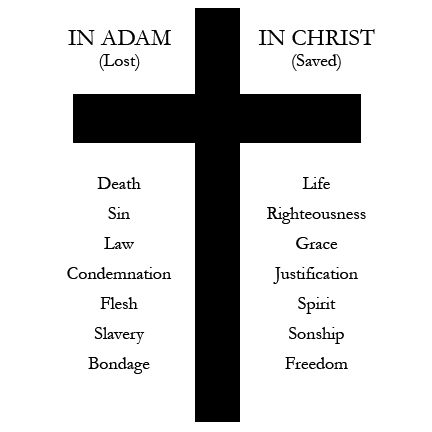
"What the one-nature eradicationist fails to understand is that death ever means separation! Separation from God is living death. I, as a new creation in the Last Adam [Christ], was positionally separated from the first Adam at the Cross (Gal. 2:20). Hence I reckon myself dead (separated) from sin and its source, the sinful indwelling old Adamic man. This is the meaning of Romans Six." mjs
11/25/2005
One of the regulars to withChrist.org suggested I create a Glossary page to help explain some of the more problematic terminology. So, here we go: GLOSSARY of Theological Terminology
11/24/2005
The Intelligent Design (ID) movement is making progress. How can we know? The secular and atheistic communities are squealing like stuck pigs--particularly their so-called scientists. These 'high-priests' of modern science remind me of the arrogant religious authorities of Jesus' day. Jonah Goldberg over at NRO muses, "Science is wonderful at explaining what science is wonderful at explaining, but beyond that it tends to look for its car keys where the light is good." His comment is a bit off point, in that it doesn't question what science really is*. What passes for science today is an aberration--an aberration which has arisen in conjunction with 'self-reinforcing' atheistic philosophies. According to an elite, only those individuals firmly committed to the philosophy of naturalism are qualified to serve in the official scientific community. And the elite are fiercely dogmatic. What's happening is that ID has challenged the secular and atheist's absolute "right" to define science as an exclusively naturalistic exercise. When the atheist "does" science, he does not approach the evidence with objectivity; rather, he/she temporarily suspends the principle of cause and effect with regard to any evidence which doesn't support their atheistic premise. For them, any talk of "design" or of a "Designer" is religion, and thus not scientific. The entire subject and current debate is all wonderfully explained in dozens of available ID books, papers, DVDs, etc. For example, visit the Access Research Network.
* See: The Soul of Science, Pearcy and Thaxton, Crossway Books, 1994.
For more links: Intelligent Design
11/20/2005
Mark your calendars, Walt Disney Pictures and Walden Media are soon to release an adaptation of the first in the series of C. S. Lewis's fictional masterpiece The Chronicles of Narnia. The Lion, the Witch, and the Wardrobe will be released in theaters December 9th. Take a tour of the Trailer and Video Clips and be sure to Enter Narnia.
Note - The above comment is not intended to be a blanket endorsement of either Disney, Walden, or C. S. Lewis. We make a distinction between C. S. Lewis the storyteller (acceptable literature) and C. S. Lewis the liberal Anglican apologist (unacceptable doctrine). Further, we do not have an inherent problem with fictional "tales." We firmly reject the notion that all fantasy is a 'gateway' to the satanic, occult, and New Age realms--still highly popular today among Pentecostal/charismatics and legalistic fundamentalists. We believe that both literary fiction and imagination have a place in the Christian life, as well as the life of children—Christian or otherwise. For many, fictional literature is the only place the concepts of truth, biblical virtue, right vs. wrong can be found. It can serve as a form of pre-evangelism. C. S. Lewis made a response in favor of moral imagination in children, shortly after the publication of The Lion, the Witch, and the Wardrobe to critics in Britain. For additional perspective, listen to Randy Testa’s commentary at http://www.walden.com/web/teach/dev. Click on Film-Related Content, then Chronicles of Narnia, then C. S. Lewis and the Moral Imagination. In addition, we are not able to assess whether this adaptation will adhere closely to Lewis' book, but we'll know shortly.
11/18/2005
Widespread ecumenical activities with Roman Catholicism by American evangelicals has been going on for decades, if not longer. Evangelicals have a hard time believing that Catholics would engage in semantics to intentionally mislead. Their naiveté typically stems from lack of direct experience coupled with idealism regarding "unity." Reference to an article "God on the Internet" (December 2005, First Things) recently caught my eye. The article's intent is to evaluate the Internet's psychological and sociological impact on religious life. The author, Jonathan V. Last, is "Online Editor" for the politically conservative Weekly Standard. Last, a Catholic, sees the influence of the Internet upon religion as more negative than positive. He writes,
Something is happening at the intersection of religion and the Internet that is like the old denominalization of American sects raised to a new and frightening power. On the Internet, those dissatisfied with what they find in their religious brick-and-mortar communities can simply retreat into a virtual world in which they are surrounded entirely by like-minded people.
Despite the fact that nearly 500 years have pasted since God brought to light again the life-giving truth of salvation by sovereign grace through faith, Catholics' still fail to grasp the essence of this protest and revolt. Consequently, their view of the Protestant Reformation is 180 degrees different from a majority of today's vast sea of born-again believers. The author's mention of "old denominalization of American sects" is a pejorative, since loyalty to Rome is the foremost virtue for every true Catholic. It is incomprehensible to them that the Risen Christ is no longer the head of their corporate body, as figured in Colossians 1:18, but rather their entire religious body "lost connection with the Head" (Col. 2:19) long ago. Despite the vast diversity within Catholicism, Catholics still console themselves about belonging to the one true church, and take a dim view of any so-called Christians who fail to acknowledge the fact, their authority, and pledge loyalty accordingly. In short, it is a threat to their ecclesiastic/political power for dissenters to be "surrounded by like-minded people."
Another concern is how the Internet is demystifying religion. One of Joseph de Maistre’s pet theories was that the authority of the [Catholic] Church depended in large part on mystery [lies and superstition]. Blogger Mickey Kaus recently wondered if the notion of mysterious silence on the part of religious institutions has become outmoded: “If you were a respected authority you used to be able to get away with maintaining a meaningful silence. Now you’ve got to be blogging in your own ‘unique voice’ about every little thing that comes up, or else some ambitious lesser authority who posts more frequently will steal your flock.” [bracket inclusions and underline emphasis mine.]
Notice the continued mention of ecclesiastical "authority."
Beliefnet’s founder Steve Waldman speaks reverently of this new transparency. “We’re now in a world where the majority of people live in democratic countries,” he says. “People haven’t grappled fully with what the implications of that are for religion. . . . People in the suburbs go to their PTA meetings and ask their principal for the budget, and they get it. . . . They ask for information about their health plan, and they get it. Transparency is all around them, and so it would just seem natural to demand that of your church. The more democracy is everywhere, the more people may, for better or for worse, attempt to demand things of religious leaders. The Internet is part of that story.”
The life of Roman Catholicism has long depended upon "mysterious silence" and the lack of transparency to maintain its corrupt religious bureaucracy. This is more self-evident of late given the continuing exposure of the magnitude of pedophilia and sexual perversion among the Catholic priests and bishops. To their credit, the American press is less likely to respect any so-called "mystery" or lack of transparency compared to foreign counterparts. The religious history and freedom of the Reformation, of the Anabaptist movement, and of America has largely been inconsistent with Catholicism's heavy-handedness. What concerns so much of the non-industrial world, and well as global Catholicism, is that the American standard of transparency is spreading worldwide due to the Internet. This is what is behind the recent outcry for global control via the United Nations over the Internet. The Internet is a grave threat to oppressive regimes--both political and religious.
In contrast to the above article, see the info line for George Barna's new book, Revolution.
Relying upon national research conducted over the past several years, Barna profiles a group of more than 20 million adults throughout the nation labeled “revolutionaries.” He noted that although measures of traditional church participation in activities such as worship attendance, Sunday school, prayer, and Bible reading have remained relatively unchanged during the past twenty years, the Revolutionary faith movement is growing rapidly [in large part due to the Internet].
“These are people who are less interested in attending church than in being the church,” he explained. “We found that there is a significant distinction in the minds of many people between the local church – with a small ‘c’ – and the universal Church – with a capital ‘C’. Revolutionaries tend to be more focused on being the Church, capital C, whether they participate in a congregational church or not.”
“A common misconception about revolutionaries,” he continued, “is that they are disengaging from God when they leave a local church. We found that while some people leave the local church and fall away from God altogether, there is a much larger segment of Americans who are currently leaving churches precisely because they want more of God in their life but cannot get what they need from a local church. They have decided to get serious about their faith by piecing together a more robust faith experience. Instead of going to church, they have chosen to be the Church, in a way that harkens back to the Church detailed in the Book of Acts.” [Bracket inclusions mine.]
One of the most eye-opening portions of the research contained in the book describes what the faith community may look like twenty years from now...Barna’s studies do not suggest that most people will drop out of a local church to simply ignore spirituality or be freed up from the demands of church life. Although there will be millions of people who abandon the entire faith community for the usual reasons – hurtful experiences in churches, lack of interest in spiritual matters, prioritizing other dimensions of their life – a growing percentage of church dropouts will be those who leave a local church in order to intentionally increase their focus on faith and to relate to God through different means.
In the effort to increase their obedience and faithfulness to God...millions of adults who are the most serious about their faith in God were the ones least likely to be satisfied by what their local church was delivering in terms of resources, opportunities, evaluation and developmental possibilities. The consequence is that millions of committed born again Christians are choosing to advance their relationship with God by finding avenues of growth and service apart from a local church.
That growth is fueling alternative forms of organized spirituality, as well as individualized faith experience and expression. Examples of these new approaches include involvement in a house church, participation in marketplace ministries, use of the Internet to satisfy various faith-related needs or interests, and the development of unique and intense connections with other people who are deeply committed to their pursuit of God.
The goal of withChrist.org is to be uniquely positioned to minister to 'hungry-hearted believers' among the 20 million individuals George Barna has identified. From time-to-time, we do receive simple questions from teens and even pre-teens, as well. We are committed to seeing a substantive spiritual awakening, rather than emotional revivalism.
11/17/2005
Here a revision of RAH's dispensational chart.

11/13.1/2005
Here are some poignant observations by Pauline dispensationalist, R. A. Huebner:
It should be understood that it was not until the truth of the mystery of Christ and the church [advent Acts 2] was unfolded [by the Apostle Paul] that God's purpose to glorify Himself in Christ, in two spheres, the heavenly and the earthly, could be made known. Silence had been kept regarding this mystery; it was not made known to ages and generations, previous to the cross.
The key to understanding the OT is that it is the history of the (fallen) first man to show that he was not recoverable, with a view to setting him aside and introducing the second Man and last Adam, through Whom God's purpose to glorify Himself is carried out. The crowning act of the first man's implacable hostility to and enmity against God, was the rejection of the revelation of the Father in the Son (John 15:23, 24), nailing the Son to the cross. This terminated the testing of the (fallen) first man to show he was not recoverable. Of course, during that time God acted in sovereign grace in the case of individuals, making saints of them. Moreover during that time God also brought in certain things (for example such things as government, priesthood, judges, kingship, etc.) wherein man failed, but Christ will take up all, wherein man has failed, and make those things good [in the Millennium], redounding to God's glory.
It is not so, as Covenantists claim, that "Dispensationalism" holds to two purposes of God--because of holding that there is a heavenly people and an earthly people. The unity of the Scriptures is seen in God's one purpose, to glorify Himself in Christ in the heavenly and earthly spheres (Eph. 1:9, 10)--Christ in resurrection, as the second Man and last Adam, having displaced the first man, the first (fallen) Adam. That there is a heavenly people and an earthly people involved in this display of God's glory in Christ is not a valid basis to say that this means God has two separate purposes and that this amounts to undermining the unity of Scripture. Such a conclusion is merely in the eye of the Covenantist beholder. It is his erroneous system which makes it appear that way to him.
Redemption is the way God changes sinners into saints who participate in the display of His glory in Christ, in the two spheres. But redemption is not what unifies Scripture. [Bracket adds and emphasis mine. DanS]
11/13/2005
As the years pass by, it's easy for older Christians to forget the "babe" stage of their born-again experience--the time when they wandered about the world like it was some grand market or smorgasbord--naively thinking that professing "Christians" were all on the same page and speaking the same language. Before we were born-again, the divisions and various controversies mattered little. However, not long into our pilgrimage the the complexity seemed overwhelming and we wondered, sometimes out loud, why the Lord would allow things to become so complicated. In an effort to cope, some adopted a "Bible only" stance, hoping to simplify matters and find the truth. Youthful idealists they were. Nevertheless, I held fast the promise of John 16:13 and continued to read and study as if my life depended on it--and indeed did.
11/12.1/2005
Is participation in politics for conservative Christians a violation of the principle of “separation of church and state”? A growing cadre of liberals, secularists, atheists, and left-wing ideologues are crying, "Yes!" Learn how to respond. Read, study, and share: Separation of Church and State?
11/12/2005
I've been playing around with publishing these Journal comments in the RSS/XML format. For those unfamiliar with the technology, click on the link. I hope have have the bugs ironed out this weekend.
11/11/2005
For those occasional and uninformed readers, media-suave Pat Robertson, The 700 Club, CBN Network, and Regent University are the zenith of the Pentecostal/charismatic movement. Yes, Robertson, like Benny Hinn, is a loopy* charismatic, albeit with more polish and wealth. Robertson's roots are in a charismatic enclave of the non-dispensational Southern Baptist denomination. How has Pat Robertson been able to rise to such religious prominence? A bit of doctrinal compromise history might be in order.
In 1956, neo-evangelicals Dr. Donald G. Barnhouse (Presbyterian) and Dr. Walter Martin (Southern Baptist/counter-cult apologist) extended the right hand of "sweet fellowship" to the aberrant leaders of Seventh Day Adventism. The ecumenical 'love-festival' allowed the Arminian works and law-center sect to join the ranks of American evangelicalism. Ten years later (1966) the 'door' to the charismatic plague was opened when Billy Graham extended ecumenical acceptance to Oral Roberts and his ministry. With that gesture, the Pentecostals (previously considered "fringe") were also allowed to join with mainstream evangelicalism. Today, American Christianity is awash with all forms of craziness. Of course the Mormon cult has been patiently waiting their turn, and it's probably only a matter of time until they can hammer out a more 'evangelical-sounding' semantic and get their pass into the 'Christian' inclusivism.
One of our regular correspondents informs me with this link that I'm behind the curve! The Mormon Church is Now Christian.
* caused by fleshly religiosity and their delusional belief of being able to work "signs and wonders."
11/6.1/2005
A well-written overview of the Alito SCOTUS nomination and an explanation of the "basic asymmetry between how the left and the right look at the Supreme Court" is found in today's edition of the Washington Post, < click here.
11/6/2005
The fact that parents, even so-called Christian parents, can rationalize sending their children to public schools is disturbing. Sure, there are some minor regional differences in school systems, but more and more the 'playing field' is being leveled by strong teachers' unions and activist judges.
Recently a federal court dismissed a lawsuit brought by California parents who were outraged over a sex survey given to public school students in the first, third and fifth grades. The ruling is sure to spread elsewhere.
The parents argued that they -- not the public schools -- have the sole right "to control the upbringing of their children by introducing them to matters of and relating to sex."
But on Wednesday, a three-judge panel of the 9th Circuit dismissed the case, saying, "There is no fundamental right of parents to be the exclusive provider of information regarding sexual matters to their children...Parents have no due process or privacy right to override the determinations of public schools as to the information to which their children will be exposed while enrolled as students."
Judge Stephen Reinhardt, writing for the panel, said "no such specific right can be found in the deep roots of the nation's history and tradition or implied in the concept of ordered liberty."Is the judge right or is he wrong? To find the answer, read our analysis of public education contained in a recent book review.
11/5.2/2005
Today, I wrote a foundational Wikipedia entry for Miles J. Stanford, together with related links to dispensationalism and J. N. Darby.
11/5.1/2005
"...overturning Roe v. Wade should be the sine qua non of a respectable jurisprudence. Chief Justice Roberts and Justice Alito will hear a lot about stability in the law, the virtues of stare decisis, and the reliance many women have placed on that decision. The obtrusive fact is that constitutional law has never been stable. Precedent counts for less in constitutional law than elsewhere for the very good reason that the legislature can correct the Court’s mistake in interpreting a statute, but the Court is final when it invokes the Constitution and only the Court can correct its own mistakes. For that reason, many justices have made the point that what controls is the Constitution itself, not what the Court has said about it in the past. Cases like Roe, that some will claim must not be disturbed, were themselves repudiations of prior understandings of the Constitution.
If judgments about the prudence of overruling are invoked, the justices should take note of the fact that Roe lies at the center of the bitter polarization of much of American society. In countries where the issue is decided democratically, no such intense animus exists. Compromises are worked out and each side knows that it is free to continue the public debate in hope of doing better next time. That was, and would be again, the case in America if the subject of abortion were returned to state legislatures and electorates. Overruling Roe would not, as some Democrats will claim, make abortion illegal, but merely the subject of democratic regulation. We have paid a high price for a ruling that rests upon nothing in the Constitution and was arrived at in an opinion of just over 51 pages that contains not a line of legal reasoning. Robert Bork
11/5/2005
"Muslim immigration has overwhelmed permissive French institutions. With a population of five million Muslims, France is holding a tiger by the ears." Brenda Walker
"Islam has become politically correct in France, notwithstanding a very real concern about fundamentalist Islam. In part, this reflects a taste for the religiously exotic that has been apparent in European and American culture for well over a century. But today it fits into a new paradigm: intellectuals, academics, even priests are not supposed to see Islam as something [un]worthy and alien but as part of a common heritage. In great measure, Islam has become a second Judaism in France: another non-Christian faith and culture with intimate relevance for the Christian world.
"This new approach gains in importance by virtue of its surprising endorsement by the Catholic Church. As Alain Besancon, a leading Catholic intellectual, has noted, 'It is syncretism in the guise of ecumenism.' To posit the Qur'an as a sacred book 'rooted in Biblical Revelation,' as do many contemporary Catholic authors or preachers, or even as a late 'Biblical book' runs not just against Catholic theology (which knows only of the canonical Bible) but aligns the church with the Islamic theological notion according to which Qur'anic revelation includes all previous revelations. As Besancon puts it, the Christian ministry is gradually shifting to a crypto-Islamic ministry: 'De propaganda fide islamica.' In contrast, it bears noting, Muslims are not in the least reciprocating, not retreating from their own indictment of the Torah and the Injil (Christian Revelation) as adulterated or falsified versions of God's word.
"Why has the church succumbed to such syncretist trends? Besancon draws a telling parallel with an earlier infatuation, that with Marxism [Communism]. Christianity may be so weak in contemporary France (and probably throughout much of Europe) that it must to look to other religions, either the apocalyptic church of Revolution or para-biblical Islam, to rejuvenate and survive. Indeed, the Catholic Church is far weaker in France today then it was in the heyday of communism in the years after World War II." Michel Gurfinkiel
11/4.1/2005
The most humorous comment this month goes to our dear 80+ and 90+ year-old correspondents (yes, they're actively in touch and on the Internet!) who wrote, "...THE PULPITS ARE FULL OF COVENANT PEOPLE, AND IT TAKES SO LONG TO SWIM OUT OF THAT GLUE." Wonderfully on point! Anyone younger than 92 years old should take note!
11/4/2005
To round out my prior comments (10/8, 10/14.1, & 10/22.1) on the SCOTUS nominations, I add these observations. The nomination of Samuel Alito confirmed my 10/8 comments. However, like Roberts, Alito may not prove potentially to be as conservative as neo-evan Harriet Miers. So-called conservative Catholics have a way of becoming wobbly as the flesh and humanistic-tendencies gain power over their natural law philosophies. And the Alito nomination will make it five Catholics among seven with Anglo-Catholic roots on the Supreme Court.
- John Paul Stevens, Democrat, nominally Protestant, secular and liberal in ideology, 1975
- Stephen G. Breyer, Democrat, nominally Jewish, secular and liberal in ideology, 1994
- Ruth Bader Ginsburg, Democrat, nominally Jewish, secular and liberal in ideology, 1993
- David H. Souter, Republican, Episcopalian (all liberal), secular and liberal in ideology, 1990
- Anthony Kennedy, Republican, nominally Catholic, secular and liberal in ideology, 1988
- Sandra Day O'Connor, Republican, Episcopalian (all liberal), considered moderate in ideology, 1981
- Clarence Thomas, Republican, natural law Catholic, 1991
- Antonin Scalia, Republican, natural law Catholic, 1986
- John Roberts, Jr., Republican, postmodernist? Catholic, multi-legal philosophy, 2005
Of course, among the original Founders not one was Catholic. Why? Because Catholics and Catholicism were the primary source of both religious and political tyranny in Europe--the continent from which the majority of the colonists had fled. One might ask, "How can any Catholic truly understand the essence of the U.S. Constitution seeing that their religious tradition espouses several tenets contrary to the very document?" Good question.
Further, the American Founders included several evangelical-like Christians, products of the Reformation. Among the realm of those who pride themselves in being heirs of that tradition (Presbyterian, Reformed, etc.), traditions which boast of carrying on a mighty cultural mandate, not a single individual has been vetted and come forward to sit on the Court! Rather odd, no?
Nevertheless, the confirmation of Judge Alito will hopefully help in moving the Court in a less judicial-activist direction and thwart liberal efforts at social engineering by fiat.
11/3/2005
In an excellent article Our Damocles’ Sword, Bruce Thornton highlights how godless materialism menaces the fate of the West. Few understand that it is America's public education that has largely taken us to this tragic juncture. Here is some fruit of this vine.
The mind-set [liberal and postmodern] behind this double standard is curiously muddled. Religious faith is deemed a quaint superstition at best, a dangerous force of bigotry and oppression at worst—if you're talking about Christianity or Judaism. But non-Western religion is prized as an expression of “diversity” superior to the West. The result is the incoherence we see today: the most intolerant and bigoted of religions, Islam, is given a pass for its depredations, while the true religion of peace––the religion of martyrs, not warriors, the religion of self-sacrifice, not conquest—is played up as a threat to the republic at home and a danger to peace abroad. Western historical behavior that was a violation of Christianity's core values is presented as typical, while jihadist violence, an aggression against the infidel entirely consistent with Islam's historical record and theology, is explained away as an aberration.
10/30.1/2005
The online version of PAULINE DISPENSATIONALISM by Miles J. Stanford is being developed. A majority of the chapters were already epublished, so this simply indexes them into one place. Completed 11/4/2005, deleted 2/2013.
10/30/2005
Wine, Women, and Psalm - the origin of American 'teetotalism' and a more effeminate church.
10/29.1/2005
I continue to be burdened by the volume of email from individuals who are biblically illiterate; it's not their fault. I can only assume that the Internet continues to become a vast mission field. The power lies in the Lord's sovereign urging for believers and unbelievers to search for information tailored to meet their particular need at the moment. God is using this means [Internet] to connect those in spiritual need with this ministry.
I've recently installed new "Donate" buttons at both websites. If you have received long-term benefit from these websites, please consider participating in the ministry.
The Lord willing, I plan to produce a series of basic, online Bible studies following my retirement. Three years and four months to the 'retirement' line. Please pray that God's mercies are extended via my employer of 21 years...it's a trial in the trenches.
10/29/2005
I have posted some articles and letters by 19th century John N. Darby on the subject of the will and responsibility under JND's page at Where They Stand. Given today's unread believer, these comments are rather deep and will require serious study for those with interest. I have progressively come to believe that the Roe v Wade decision unleashed a cult of autonomy throughout American society. Media (even religious media) continues to bombard us with the myth and lie regarding human autonomy and so-called free will. Rather than being able to discern the anti-biblical nature of these humanist tenets, Christendom has 'shape-shifted' into something that bears little resemblance to biblical Christianity.
10/22.1/2005
Another week of controversy over the Harriett Miers nomination. As more information is uncovered, the indications are not positive. There is too much uncertainty about how her mind works, or doesn't. Her evangelical faith my be as spurious and superficial as the faith of George Bush*. These products of neo-evangelicalism make much to do about their "faith," but have little to say regarding the object of that faith. Faith without truth leads to self-righteousness, and consequently this faith is worse than worthless.
"...true faith must be based solely upon scriptural FACTS, for 'faith cometh by hearing, and hearing by the word of God' (Romans 10:17). Unless our faith is established upon facts, it is no more than conjecture, superstition, speculation, or presumption." MJS
Further, the mounting evidence strongly suggests that Bush and Miers might both be unprotected against the satanic deception so widespread in today's world. This protection is only available on the other side of the Cross! See God Sovereign - Satan Servant and The Verse Snatchers. President Bush may have given up consumption of alcoholic beverages, but what he's been drinking spiritually is infinitely more harmful.
*http://www.whitehouse.gov/infocus/ramadan/quotes.html The Administration's adulation of Islam is long on political correctness and short on historical fact.
10/22/2005
Evangelicals and born-again Christians fail to understand that BOTH Islam and Catholicism do not show their true face in America. These religious adherents operate in stealth mode while they are in the minority, then radically change when they gain power. One must look outside America to where these religions are politically sanctioned (e.g. the Middle East and Central America, respectively) to see and understand their true character--and their inherent opposition to genuine Christianity.
10/16/2005
The Jewish psalmist's lament [Psalm 89:47,48] over the downfall of the Davidic dynasty....
How long, O Lord? Will you hide yourself forever?
How long will your wrath burn like fire?
Remember how fleeting is my life. For what futility you have created all men!
What man can live and not see death, or save himself from the power of the grave?
Warning: Intense Graphics. Here is a 1.8M .mpg video file (pre-marketing for Microsoft's XBox game appliance) that vividly captures a truth about life. "Life is short." Of course, the company's point is that consumers should "play more." The Apostle Paul would have understood these pagans' motivation--for if Christ be not raised from the dead then "tomorrow we die." (1 Cor. 15:32)
10/14.1/2005
The Harriett Miers confirmation hearings will have the potential for creating national dialogue on the subject of the relationship between politics and religion, as well as the meaning of the oft bantered phrase "separation of church and state." Things are already heating up. I hope to find time to write a short article which cuts through the debate and take aim on Democratic and left-wing secularist propaganda that conservative Christians are 'second-class' citizens and disqualified from participation in the political process--i.e., without the right to vote or hold office.
10/14/2005
For those regular correspondents who have entered us into your email address books, please be aware that the joimail.com address is no longer viable. Please use the address shown under the "Write Us" link. Thanks!
10/8/2005
This has indeed been an interesting week. In my opinion, Michael Medved has the most poignant comments regarding the Harriet Miers nomination to the Supreme Court of the United States (SCOTUS). He quickly discerned that this nomination has the potential of publicly exposing the Democrat's and liberal's anti-Christian hatred and bigotry toward who he calls "born-again evangelicals." He also states that the repeal of Roe vs. Wade is not an "if", but a "when."
Those who understand the gravity of the nomination (both on the left and on the right) have been living in different forms of emotional angst. Those 'conservatives' who seem the most uncomfortable appear to be part of the elite, conservative Catholic intelligentsia (NRO, Ann Coulter, Laura Ingraham, William Kristol, etc.) together with the political libertarians. They wanted another high-powered, natural law, intellectual like John Roberts. The Catholics arrogantly look down and have contempt for born-again evangelicals. Ms. Miers' past history does contain a fair amount of contradictions; however, these may be explainable by her shift in worldview, pre and post conversion--a rather common phenomena in the born-again community--e.g., myself.
Here are some truisms that we all need to keep in mind as the fight looms on the horizon.
Neither Christians nor Christianity are obligated to tolerate reprehensible behaviors. Jesus didn't; Paul didn't; and neither should you! The Apostle Paul gave clear direction for dealing with both moral and doctrinal deviancy in the church. Outside the church, he acknowledge the God-ordained role of government to punish evil. It is nonsense to believe that Paul would defer to government in the public arena, but then remained silent regarding what, by definition, constitutes "evil." This would in fact turn his own teaching in 1 Timothy 1:8-11 on its head.
Christians are full citizens with civic rights and responsibilities to participate in the process by which society determines what constitutes "reprehensible behavior."
Democrats, secularist, and liberals are engaged in a campaign to disenfranchise religious conservatives and deny them this civic right (say, "hypocrisy") based on a twisted concept of the phrase "separation of church and state." They must be stopped and exposed!
10/2/2005
Of late, the mail box here at withChrist.org has been full of letters from young believers struggling with the subtle, sometimes overt, teaching of "kingdomization." Be it a non-dispensational bible study or a non-dispensational church (denominational or otherwise), the rally cry and mantra is the same--KINGDOM and COVENANT. Even many so-called sound dispensational churches have jumped on this popular religious bandwagon! In light of both secular and religious pressures (Islam), the emotional lure is understandable. People yearn to see the King and His Kingdom as pictured in the OT. Cannot the righteous triumph over evil? Sadly, the history of Christendom is largely the saga of the so-called "Church" becoming the forced and tortured heir of Israel's inheritance--the King's Millennial Kingdom. This error began shortly after Pentecost (Chapter 2 of Acts) and over centuries became what is known as Christendom. This religious behemoth shares little in common with the heavenly Body and Bride of Christ. To help address questions, I've created a new articles section--KINGDOMIZATION. As time and need permits, I will post links to writings and polemic papers dealing with this theological error.
10/1/2005
Community Bible Study, the Herndon, Virginia based interdenominational* organization, was created in the mid '70s to study the Bible (non-dispensationally) and thus make so-called "disciples." This organization was founded by a group of women (not again!) from around the Washington, D.C. area. If you're new to withChrist.org, you might ask, "What the problem?" Listen to the testimony of this correspondent:
I am currently attending a "Community Bible Study." We are doing a study called Return to Jerusalem and we are doing quick overviews of the prophets (if that is possible) and we are in Daniel right now. In studying Daniel's prayer in chapter 9, they are trying to make applications to our prayer life in the study. The question they posed is: God still desires to answer the prayers of His people. What do the following verses tell you about the prerequisites for answered prayer? They then listed these Scriptures to reference: Isa.59:1-2, Eze.14:1-3, Mark 11:24-25, James 5:16, 1Peter 3:7, 1John 3:21-23, and 1John 5:14. I listened to some of the answers which related to how our behavior determines whether God will answer our prayers, such as if we don't forgive, God won't forgive us. I tried to explain [to the group] that we are to forgive as we have been forgiven, etc. I tried to explain that these passages were related to Israel and that we can learn from them, but that God dealt with them [Israel] conditionally.
I have studied the articles on your site and have learned a lot. Thank you for that. I now have some understanding of what the Bible says. I consider myself a Pauline Dispensationalist, so I understand "rightly dividing the Word of God." However, I'm starting to question whether this Bible study may be the reason confusion is setting in to my thinking.
The experience of this individual is both normal and healthy. Armed with a dispensational frame of reference, the problems of a non-dispensational approach to study soon become evident. The "problem" with all non-dispensational approaches to studying the Bible is that they lead to confusion of mind and finally...bondage. Over the years, we have often received email from so-called non-dispensational 'disciples' testifying how they wandered in a spiritual 'wasteland' for decades. Non-dispensational Bible studies logically place the believer back on the ground of a devout Jew—under Law—i.e. the problem dealt with by Paul in the Book of Galatians. It really can’t be otherwise, when the Scriptures being indiscriminately applied to the believer are mostly from the OT, Synoptic Gospels and General Epistles--the status quo for much of the denominational world. Note the fact that none of Paul’s Epistles appear in the scripture references listed above. The bottom line is this, non-dispendational Bible studies lead to the inevitable co-mingling of law and grace. Again, breathe deep Miles J. Stanford's introductory comments:
It is absolutely essential for the believer to learn the scriptural difference between:
- his relationship to earth and heaven,
- the flesh and the Spirit,
- Judaism and Christianity.
Only from the Pauline epistles will the Holy Spirit minister these Christian truths to him. Then, when established and hid with Christ in God, he can be ministered to by the remainder of the Word without being drawn from his position in Christ, Who is his Life.
* Interdenominationalism seeks to respect all religious traditions no matter how doctrinally heretical they might be. The interdenominational philosophy is tailor-made for success in our postmodern culture. Nondenominationalism seeks to diminish any and all doctrinal distinctions or differences by descending to the level of the lowest common denominator. The end is doctrinal illiteracy.
9/30/2005
Four decades ago, Christian, spiritual growth author Miles J. Stanford wrote:
Crossless Fundamentalism - Fundamentalism is in bloat* today. Churches are crammed with Crossless Christians--fundamental believers who are in no position to escape Neo-evangelical, to say nothing of charismatic influence. Churches turgid with torn hearts, insurmountable problems within, overpowering problems without. Blessed needs! They will come unto Him as their Life when they see that Cross-life at hand. “Sir, we would see Jesus” (John 12:21).
Crossless Neo-Evangelicalism - Much of Neo-evangelicalism is at the end of its theological tether, dangerously dangling over the void of a questioned Bible. Their penetration principle has failed in the face of deadly denominational détente. Neo-evangelicalism’s neo evangelism is choking the scene with the grey ash of least-common-denominator “commitments”--counterfeit (spurious) conversions. “Converts,” spurious or otherwise, for the most part doomed to denominationalism.
* - the typical imagery is that of a sun-baked, dead carcass expanded with a lot of hot air.
Thus, it is extremely heart-warming when we receive email from correspondents like the following:
Dear Dan,
I just wanted to drop a note to tell you what a help and a blessing the website has been. I'm a new, born-again Christian (5 years Oct 26) and started out charismatic, then Reformed and now by the Lord's leading and direction finally to the truth of Pauline Dispensationalism. As I longed for the Truth, the Lord continued to show me. I feel as if I've been freed since learning how to study and read Scripture. It was on Mother's Day of this year that I vividly remember how, through reading God's Word, I realized that now all the confusion was gone, and everything fell into place, especially my position IN CHRIST. What joy and gratitude I have! And it is so helpful to have teachings like your's online, because as you know, very little, if any Pauline truth is taught in the "church". So, thank you for the work you are doing and I pray that God will bless you both as you serve Him, who is The Head...Jesus.
Your sister in Christ,
[signed]
It is the mission of this ministry to nurture young believers like the one above...those who have become weary of chasing so-called ''signs, wonders, and spiritual gifts" or seeking to gain control of the flesh by means of the Law as a 'rule of life'...when in fact, the law is but a 'rule of death'.
9/25/2005
This past several weekends have included long overdue landscaping projects around the hacienda before the snow begins to fly here in the Rocky Mountains. Recuperation of my lower back continues in a positive direction, but some arthritis in several of my joints seems to be the new phase of getting older. Thank goodness for prescription drugs.
The faster DSL connection is now operating, and this should help build a base for more future website resources and enhancements--time permitting. Lord willing, I would like to shift to working only part-time in about three years, thus freeing up more time for website management and correspondence. Your prayers and support will be appreciated. With the new DSL service, I've obtained a new email address which should be online shortly. The dans X withChrist.org (spaces removed and replace X with @) has always been and will remain the official email address for this website. However, the response address will shortly be the newer msn.com address.
9/18/2005
This quote is from Bruce Thornton's, The Forbidden History, a favorable review of The Legacy of Jihad. Islamic Holy War and the Fate of Non-Muslims edited by Andrew G. Bostom. Click on the quote above to pull up the review. Why is it important for Bible-based Christians to understand the nature of true Islam? First, it's important because Christian's shouldn't be party to the 'grand lie' that this is a religion of peace and tolerance. Second, because it will likely be the continuation of their "holy war" against the West, and the West's continued denial of these facts, that sets in motion the need for global governance (both political and religious) spoken of in the last book of the NT--Revelation. The world today is not the world of yesterday. Given the enormity of the threats (nuclear attacks on US cities), it will be only reasonable for citizens of all nations to be asked to relinquish their civic freedom and to submit to an 'all-knowing' global State. Despite this dire future, it's important to remember these words:
The sovereignty of God is what alone gives to the Christian heart comfort in view of a world full of evil, which is gone astray from Him. To know that after all, in spite of the rebellion of the creature, things are as absolutely in His hand as ever they were--this brings, and alone brings, full relief.
Still He rules over all, and where evil cannot be turned to good, limits and forbids it: He maketh the wrath of man (and Satan) to praise Him, and the remainder of wrath (what would go beyond this) He restrains [Psalm 76:10]. F.W.Grant
9/16/2005
For those looking for a brief but good study guide, see Hamilton Smith's THE EPISTLE TO THE EPHESIANS. Mr. Smith was a Plymouth Brethren writer during the early 20th century. I quote from the booklet:
In order that we may receive the great truth of the Church on divine authority, the Apostle [Paul] is careful to explain that he acquired his knowledge of "the mystery" of the Church, not through communications from men, but by direct revelation from God, even as he says, "By revelation He made know unto me the mystery." This meets a difficulty that may rise in connection with the truth of the mystery. When Paul preached the Gospel in the Jewish synagogues he invariably appealed to the Scriptures (see Acts xiii. 27, 29, 32, 35, 47; xvii. 2, etc.) and the Jews of Berea are expressly commended inasmuch as they searched the Scriptures to see if the word preached by Paul was in accord with them. But directly the Apostle ministered the truth of the Church he could no longer appeal to the Old Testament for confirmation. It would be useless for his hearers to search the Scriptures to see if these things were so. The unbelief of the Jews made it difficult for them to accept many truths that were in their Scriptures, even Nicodemus failed to grasp the truth of the new birth, but to accept something that was not there, and which set aside the whole Jewish system that was there, and which has existed with the sanction of God for centuries, was to the Jew as such an insuperable difficulty.
Opposition there must be, for these great truths [of the Church] entirely undermine the worldly constitution of every man-made religious system. Is the truth of the mystery, with the knowledge of which Paul sought to enlighten all men, proclaimed from the pulpits of Christendom, holiness conventions, or even from evangelical platforms? Is the truth of the mystery, involving the total ruin of man, the utter rejection of Christ by the world, the session of Christ in the glory, the presence of the Holy Spirit on earth, the separation of the believer from the world, and the calling of the saints to heaven--is this great truth proclaimed, or acted upon, in the national churches and religious denominations of Christendom? Alas! it has no place in their creeds, their prayers or their teaching. Nay, more, and worse, it is denied by their very constitution, their teaching and their practice.
Those looking to read some of the original Plymouth Brethren writers will find the online library of STEM PUBLISHING CO a great resource. Please do not interpret this recommendation as a 'blanket endorsement'. The believer must always exercise discernment.
9/11.1/2005
A number of you are experiencing problems with email. When I attempt to respond, I'm getting blocked. My response will originate from dansm @ joimail.com, without the spaces. If you place a general domain block to filter spam from the joimail.com domain, I will be unable to respond to your email. I am considering changing the email domain, but it won't possibly take place for a few months.
9/11/2005
From time-to-time, we receive email from individuals asking about the exchanged life movement, Association of Exchanged Life Ministries, Cross Life Books, etc., as well as some who assume that Miles Stanford was associated with this realm. This is a common misunderstanding. For over four decades, some exchanged-life leaders were in direct contact or in correspondence with Miles regarding his understanding and articulation of the Pauline truths of identification. However, Miles never participated in their ministries or associations. In fact, Miles Stanford was forced to write numerous polemic papers to counter a broad number of doctrinal errors.
The general characteristic of the exchanged life movement is their attempt to synthesize Pauline 'identification truth' with failed psychological theories and dubious counseling methods. Further, they often try to build upon non-dispensational, Arminian, holiness, and sometimes even demonist/charismatic-oriented theology. The movement has been a key source in spreading the eradication (one-naturism) error.
We quote from the history of the Association of Exchanged Life Ministries as published on their website.
From 1969 to 1986, Grace Fellowship International [Dr. Charles Solomon] existed as a parent organization to five branch office [sic] located in Denver, Colorado; Atlanta, Georgia; Indianapolis, Indiana; Springfield Missouri and Tampa, Florida. Each of these ministries counseled, trained and discipled using materials based on what is known as Exchanged Life Truths.
In 1986, the five branches were spun off as separate corporations and became independent of Grace Fellowship International......With this change, the five original branch offices adopted an associational structure, allowing them to be independent and yet voluntarily accountable to each other.
The seven original members of the association were Exchanged Life Ministries [Lee LeFebre] (Denver, CO); Gillham Ministries [now Lifetime Guarantee], (Fort Worth, TX); Grace Fellowship International (Denver, CO); Grace Fellowship Atlanta (Atlanta, GA), which is now Grace Ministries International; Grace Fellowship Indianapolis (Indianapolis, IN); His Life Ministries (Springfield, MO); and Grace Fellowship of Tampa Bay (Clearwater, FL) which is now Life Exchange Ministries.
In the late '60s and early '70s, psychologist Dr. Charles Solomon was a correspondent and private student of Miles Stanford. Miles spent many hours with him in one-on-one discussion seeking to cultivate a correct understanding of the doctrinal truths of identification and spiritual growth. Being new to the realm of growth, the doctor was advised to "go slow" and to avoid viewing identification truth as something which could be "used" mechanically as a counseling tool. Nevertheless, his clinical bent prevailed and Dr. Solomon influentially set the bad example of combining the growth truths with psychology--further placing it all upon a non-dispensational and one-nature theological foundation. As they say, "The rest (of the mess) is history."
9/5/2005
Our Nation's resilient financial system is what often sets us apart from many other nations around the globe. Its ability to withstand crisis allows for economic healing and restoration. It has been a model to others looking to bring stability to their nations and societies. As a small part of my 'day' job, I review Disaster Recovery/Business Continuity Plans for financial institutions. Banks are required to assess various disaster risks, formulate recovery and continuity plans, and then test them in a mock 'walk-through'. Nevertheless, the common saying stands, "The disaster you get is seldom the disaster you plan for." This certainly was the case with Hurricane Katrina. Even if local and state authorities had adequate plans and had tested them (early indications are that they didn't), it's doubtful they envisioned the catastrophic nature of the events that actually unfolded. Contingency plans require people to implement them. If the people are unavailable or missing due to the scope of the disaster, the plan will prove ineffective. With that said, it's disgusting to see and listen to the cacophony of criticisms. The Federal government has always been a secondary resource of relief--coming to the assistance of local and state authorities when necessary. The Federal government has never been expected to be first on the scene. Having a full understanding of the scope of a problem is vital to implementing any effective response. To better understand the complexity of the problems the Gulf Coast is facing, read the following commentary: An Unnatural Disaster: A Hurricane Exposes the Man-Made Disaster of the Welfare State
9/4.1/2005
The following quote is from Robert Spencer's book, The Politically Incorrect Guide to Islam (and the Crusades). Mr. Spencer's website is Jihad Watch.
ISLAM AND CHRISTIANITY: EQUIVALENT TRADITIONS?
PC Myth: The problem the world faces today is religious fundamentalism
Is every religious tradition equally capable of giving rise to violence? This notion, widespread as it is, would have a lot more credibility if Pat Robertson and Jerry Falwell were writing articles defending the stoning of adulterers (as did the Switzerland-based Muslim writer Hani Ramadan, who published an article in the French journal Le Monde in September 2002 doing just that), or calling for the killing of blasphemers (blasphemy is a capital offense in Pakistan and elsewhere in the Islamic world), or flying planes into the iconic buildings of those they considered enemies.
That evangelical Christians do not commit these acts is one clear indication that not all “fundamentalisms” are equivalent. Contrary to the deconstructionist views that prevail on college campuses today, religions are not simply raw material that can be fashioned into absolutely anything by believers. There is considerable overlap in the behavior of religious people in all traditions. For example, they pray, meet together, and perform certain rituals. Sometimes they even commit violence in the name of their religion. But the frequency and commonality of such acts of violence—and how close they are to each religion’s mainstream—is determined to a great degree by the actual teachings of each religion. Islamic apologists like to point to Timothy McVeigh and Eric Rudolph as examples of Christian terrorists, but there are three reasons why McVeigh and Rudolph are not equivalent to bin Laden and Zarqawi:
They did not even attempt to justify their actions by reference to Christian Scripture or tradition.
They were not acting on mainstream Christian teachings.
There are not large Christian groups around the world dedicated to implementing the same teachings.
The difference between Osama bin Laden and Eric Rudolph is the difference between aberrant acts and aberrant teachings. Any human being with a belief system can do abominable things. But abominable acts are more likely to come in greater numbers and frequency when they are encouraged and perpetuated by religious texts and those who teach from them.
But surely you’re not saying that Islam is the problem?
What is the alternative to the Ridley Scott (Left-wing, British film producer responsible for the grossly inaccurate movie--Kingdom of Heaven) view that “fanaticism” is causing all our troubles today? It’s a view that PC types just can’t understand: The problem is within Islam and will not go away, or be neutralized, until this fact is recognized.
To say that the problem is within Islam is not to say that every Muslim is the problem. As we have seen, many who identify themselves as Muslims have only a glancing acquaintance with and interest in what Islam teaches. No, to admit that global jihadist violence indicates a problem with Islam is simply to be honest: There are groups around the world that believe that it is their responsibility before God to wage war against non-Muslims and impose Islamic law, first on Muslim states and then on non-Muslim states. This is a core motivation behind terrorist violence today, and it is rooted in the teachings of the Qur’an and Sunna (Islamic tradition).
Some analysts fear that if Western authorities begin to acknowledge that America’s foe in the War on Terror is not a bunch of hijackers of Islam, but people who are working from core Islamic teachings, we will soon be embroiled in a war with the entire Islamic world. This will certainly make it harder to perpetuate the sham alliances that now exist with the Saudis, the Pakistanis, and the Egyptians. But it would also allow the United States to call those putative allies to account for their allegiance to the global jihad and to give real substance to President George W. Bush’s post–September 11 announcement to the world that “you’re either with the terrorists or with us.”
Others have shied away from admitting the deep crisis in Islam today on the pretext that it will demoralize and anger moderate Muslims. If they are genuine moderates, there is no reason why this should occur. No problem can be solved unless its source is identified. A doctor who treats persistent headaches caused by brain tumors with aspirin will not escape malpractice suits for long. If any moderate Islam project is to succeed, it will only do so by identifying the elements in Islam that give rise to violence and terrorism, and working in whatever way possible to change Muslims’ understanding of those elements so that jihadist recruiters can no longer convince young men to join them by appealing to their desire to live out “pure Islam.”
Whether moderate Muslims can actually succeed in changing millions of Muslims’ understanding of Islam is an open question. But it has no chance whatsoever of happening unless they acknowledge why Islam creates people like bin Laden and Zarqawi.
Listen to Michael Graham's 9/2/2005, stunning 4-part interview with Robert Spencer here.
9/4/2005
Some have asked about providing specific aid to those affected by Hurricane Katrina via "good independent bible churches in the gulf area involved in relief and outreach." While recommendations are always problematic, I encourage readers to use the Internet to identify those who might be in the best position to receive funds. I've done some research using Google and have identified possible candidates which I've listed below. These churches are evangelical and generally dispensational. As more information becomes available, I will add to or revise the list. Keep in mind, I am currently not nor have I been in direct contact with any individuals from these churches. Also, websites for churches in the disaster zone may be operational (because their web server was located elsewhere) but church personnel may be unavailable.
Maranatha Bible Church, River Ridge, LA
Berean Bible Church, New Orleans, LA
Fellowship Bible Church, Metairie, LA
Grace Bible Church, College Station, TX
McLean Bible Church, Washington, DC
Trinity Church, Covington, Louisiana
9/2/2005
As I've listened to the news coverage, read commentary, and have reflected upon the nature and magnitude of the most recent natural disaster--Katrina, I've formulated a few thoughts.
- Comments by Pentecostal/charismatic media voices that Katrina was God's judgment on America are simply unbiblical and very bad theology. Shame on them. Similar comments by Muslims are more an extension of their doctrinal teaching to kill or subdue infidels in their drive for global Islamic theocracy. Darkened minds!
By contrast, Jesus said:
He [the Father] causes His sun to rise on the evil and the good, and sends rain on the righteous and the unrighteous. Matthew 5:45
Now there were some [disciples] present at that time who told Jesus about the Galileans whose blood Pilate had mixed [after having murdered them] with their [Jewish religious] sacrifices. Jesus answered, "Do you think that these Galileans were worse sinners than all the other Galileans because they suffered [death] this way? I tell you, no! But unless you repent, you too will all perish. Or those eighteen who died when the tower of Siloam fell on them--do you think they were more guilty than all the others living in Jerusalem? I tell you, no! But unless you repent, you too will all perish." Luke 13:1-5
Apparently, repentance is an important matter with the Son of God--the Lord Jesus Christ.
- The humanistic thinking of some Americans and their elected leaders, many media pundits, as well as left-wing politicians is shockingly arrogant. Natural disasters have always occurred, but today's widespread expectations of what government should do or should have done to mitigate these disasters is incredible. This has come about due to the humanistic societal expectations (collectivist impulse) combined with the tenet that mankind (government) is God and thus is responsible to entirely offset the effects of the Fall. Phillip E. Johnson in his excellent book, REASON IN THE BALANCE, touched a bit on the twisted attitude of today's modern citizen:
Everyone has a right to live exactly as he or she pleases, but if something goes wrong, some abstraction called "society" is to blame and must pay the bill for damages
The savings and loan debacle of the 1980s was not an isolated incident but a paradigmatic example of the delusionary character of American thought near the end of the twentieth century. The S&L [financial bankruptcy] debacle occurred because the government freed financiers to make risky investments and at the same time insured the depositors who put up the money from any loss
The same generous public policy applies to individual behavior. Everyone must be free to make risky choices, and everyone must be protected from unpleasant consequences by social insurance [federal deficit spending] that is ultimately provided by government, which is to say by nobody [i.e. all holders of debauched U.S. dollars].
Bottomline: Natural disasters are commonplace because the world has suffered cosmic ruin from the Fall. Societies have never possessed the wealth nor the resources to entirely mitigate the wrath of earthly disasters. The current global sensibility that mankind can accomplish anything imaginable is a resurrection of the humanistic spirit revealed at the Tower of Babel on the plain of Shinar. Read Genesis 11:1-9.
8/21/2005
This is a rather short weekend for me--back from traveling to Albuquerque on business (with its growing crime problems) and on route to Chicago, so the comments will be brief. However, I do encourage readers to visit Red Giant and read his comments on the Gaza pullout--Tisha B'Av . Radio hosts Dennis Prager and Hugh Hewitt (elder in a PCUSA church) are at odds with that liberal denomination's anti-Israel position and decisions. Mr. Hewitt, an above-average, rational, ex-lawyer still hasn't discovered the link between liberal political/social positions and their foundational liberal theology. Thus, I keep hoping and praying for some form of epiphany relative to cause-effect logic.
8/14.2/2005
The Nation grieves for the families of our brave soldiers who have fallen in battle. Being the parent of a son in the U.S. military who also has been at risk of death or dismemberment, I believe I have a fair grasp on both the intellectual and emotional issues. However, I must admit that I have little sympathy for the Left-wing-nut, Cindy Sheehan. Seeing that she disrespects her son in death, I can imagine that she also disrespected him in life as well. Here is an individual who refuses to take responsibility for her own failure (that of a liberal parent in not raising him to share her anti-war values), or acknowledge the responsibility attached to her son's noble decision to become a soldier. Being a parent involves doing your best to provide values and direction for children, but it also involves acknowledging that adult children are responsible for their own decisions, as contrary or painful as they might be. As for her latest tax protest, I wonder if she and her political cronies would allow all Americans who dissent on legalized abortion and public education to stop paying their taxes as well? For the hypocritical Left, it's not likely.
The President and his Administration's failure to secure the Nation's borders will probably go down as one of biggest domestic policy blunders and moral failures of the decade. America's southern border is being overwhelmed by violence, crime, and property destruction associated with the smuggling of drugs and human-cargo into the United States. New Mexico's Gov. Bill Richardson was forced to recently declare a 'state of emergency' in counties on the border. Of course, Mexico has suffered for centuries from spiritual darkness, corruption, crime, and poverty--the social fruits of Catholicism. Quite obviously, George Bush sees it differently.
8/14/2005
Sixties Dope Heads Granted Academic Tenure as Scientists? The radical secularists who maintain a hegemony over the 'scientific community' are really desperate. While American tax dollars go to fund research into cosmic string theories (which they willingly admit are scientifically unprovable and thus more philosophic speculation than science*), they adamantly object to the suggestion that Intelligent Design be given a small voice in the discussion of origins. In response, a long-time acquaintance of mine writes:
To say that the Earth, with all its varied complex systems (particularly biological), came about by chance with no intelligent direction or director is a belief that is rather anti-scientific and unreasonable. The great principle of cause and effect, which must be the basis of all logic and reasoning, would indicate that evolutionary theory as presently held does not meet this fundamental principle of science. The intelligent design position is simply restating this principle of cause and effect from the scientific evidence now available. Therefore, to imply that it is unscientific is a falsehood. The truth as regards scientific theory is not necessarily found by majority vote, as it were. "Intelligent design explains nothing and predicts nothing; it isn't even a theory." On the contrary, intelligent design gives the only adequate cause for the effect we see in nature and predicts that we should expect to find the truth in the direction of the universe being a designed and ordered system. It is not rational to think otherwise.
* - Similar imaginative theories on reality and the universe have circulated among New Agers and the hallucinogenic drug crowd for decades.
8/13.1/2005
The award for the best family movie seen in our house for July-August (my wife says "EVER...!") goes to Secondhand Lions, staring Robert Duvall, Michael Caine, Haley Joel Osment, 'Julia Roberts' look-a-like Krya Sedgwick , and a lion, a giraffe, and several wonderful dogs. Here's proof that Hollywood can produce top-notch films that can be appreciated by the Christian community. This is not a "Christian movie," per se, but the themes are classic, heart-warming, and the movie is unique in celebrating the male ethos at a time when masculinity is in short supply in American culture.
8/13/2005
It's been 40 years since I entered high school. The lapsed time was driven home this weekend by the death of a football teammate. The cultural changes that have occurred over the past four decades are immense. The West, and particularly America, has lost a fair amount of social cohesion; due to the affect of public education, balkanization, and the global village--largely the result of the speed of communication brought about by the Internet and the glut and information from New Media. For the most part, gone are the neighborhoods where people assumed a high-degree of commonality. As masterfully explained by Philip E. Johnson in his Reason in the Balance, American society has polarized into those who believe in God and retain a Judeo-Christian worldview and those who are secular or have embraced tenets of the humanistic secular viewpoint. What I never expected to see, was the devastating effect upon fundamental and evangelical churches. The popularization of postmodern ideas has taken a heavy toll on denominations and groups at one time committed to the knowledge of biblical truth. Following after truth and safe and sound biblical doctrine most often leads pilgrims down very lonely paths, socially speaking. Feeling the brunt of this today are young, single, born-again Christians in their twenties. They desire to follow the Lord and grow spiritually, but are often at a loss for fellowship and healthy social interaction. Older Christians are not excluded, but it's more of an exception rather than rule. Gone are many of the "fundamental Bible churches" of yesterday, due to their inherent instability of attempting to find some "middle ground" between religious humanism (Arminianism) and biblical revelation (Sovereign Grace) and their inability to definitively present the doctrine of biblical Christian living. On a practical level, many born-again folks have limited opportunities for meeting members of the opposite sex, if their path excludes attending a "Christian" college. Further, "meeting the 'right' person" is often narrowed to four short years, longer if one does graduate work.
All of the above is a long introduction for recommending to any of my single readers e|Harmony.com. Forty years ago, the accepted "view" for meeting a potential spouse in fundamental and evangelical circles involved an over-emphasis on God's providential workings. Much of the harmful over-emphasis was addressed with Garry Friesen's DECISION MAKING AND THE WILL OF GOD, Multnomah Press, 1980. I believe e|Harmony.com fits within Friesen's "Wisdom Approach" model. For those born-again Christians who are single, or who have become single again through divorce or being widowed and are dealing with loss of companionship, I encourage you to tap into this resource. PS. I do not recommend online dating or matching services in general. e|Harmony.com is unique.
8/7/2005
The Left and Liberal intellectuals' obsession for linking "radical" Islam to "fundamental" Christianity, is exposed in Bruce Thornton's most recent article/review, The Myth of Islam Busted - Review of The Myth of Islamic Tolerance. How Islamic Law Treats Non-Muslims, ed. Robert Spencer.
“... centuries of mythic idealizations that continue to obscure the true nature of Islam, leading to the strange phenomenon we see nearly every day: non-Muslim Westerners “hastening,” ... “to assure the public that the Islam of the terrorists is not the 'true Islam,' which is, they maintain, a benign and tolerant thing.”
7/31.1/2005
The Myth of "Moderate" Islam. Here is the link to Bruce Thornton's most recent post. Doublespeak Unveiled--Muslim “moderates” are true to spirit of Islam. For many, the "moderation" is only skin deep.
7/31/2005
The communication chain from God’s mind to ours does not consist of inherently impeccable links. We do not need the original autographs of Scripture, neither do we need the Pope or Magisterium to ensure either veracity or understanding of the truth. For the born-again, growing believer, the efficacy of the connection (i.e., knowing the "mind of Christ"--1 Cor. 2:6-16) is guaranteed by the sovereign activity and oversight of the Living Word—the Risen and Ascended Lord Jesus Christ as expressed through the Holy Spirit's ministry.
However, when He, the Spirit of truth, has come, He will guide you into all truth; for He will not speak on His own authority, but whatever He hears He will speak; and He will tell you things to come. He will glorify Me, for He will take of what is Mine and declare it to you. All things that the Father has are Mine. Therefore I said that He will take of Mine and declare it to you. John16:13-15.
Want to know more. We recommend:
From God to Us--How we got our Bible, Norman Geisler & William Nix, Moody Press, 1974. This paperback book covers basic facts about the origin of the Bible: inspiration, the biblical canon, major manuscripts, textual criticism, early translations, and modern versions. While written for non-scholars, the authors do not gloss over difficult and complex issues.
The Word of God and The Mind of Man, Ronald Nash, P&R Publishing, 1982. This paperback book [technical] "is an exploration of the extent to which the human mind can receive and understand divine revelation" and primarily deals with postmodernism's theories and their affect upon contemporary theology. This book is written at the post college graduate level.
7/30/2005
By now, every believer living in America has heard of the King James Only argument and viewpoint, which, since the late '60s has become an annoying movement. A recent email chided us for being uninformed and "completely ignorant of the facts." Consequently, I put together some basic and brief thoughts on the matter. See King James Only?
7/29/2005
One reader writes, "I was very alarmed to read your blog article about Mr. Williams' coming book. Do you think God would allow Al Qaeda to literally wipe out the US? Prophetically speaking, where does Islam fit into end-time events?"
Ans. Despite those early American Christians who attempted to make a “covenant” with God on behalf of America, I don’t believe man-made covenants are binding (in God’s eyes) and thus, I believe God could allow al Qaeda to make good on their plan. As for prophecy, there is much speculation (at least one converted Muslim interprets Islam to be the “Beast” spoken of in Revelation) of which I have little time to evaluate.
7/24.2/2005
For those unaware, the Reformed community (Covenant Theology) is again embroiled in a serious civil war regarding the meaning of their quintessential Reformation doctrine--justification by faith. This occurs because of a lack of understanding of the believer's History in the First and Last Adam, together with their non or anti-dispensational perspective. Nevertheless, a number of their scholars have taken issue with the traditional (Reformation confessional) understanding of the Apostle Paul's teachings as found in his Epistles. "Many authors* who are sympathetic to the new perspective also insist that we need a new or fresh look at the Pauline epistles, one that is freed from the constraints of the older Reformation reading." No, they haven't opened a door to any dispensational perspective; rather, the New Perspective on Paul emphasis appears to be a move at the "re-reading of the Pauline epistles against the background of the new understanding of [covenant] Judaism."(1) At issue is the meaning of the Law, imputation, justification, sanctification, and works. Here is one of many explanations: The Justification Controversy: A Guide for the Perplexed. Unfortunately, the 'covenant' paradigm will again ensure little progress toward understanding Paul's heavenly Gospel given by the Risen Lord Jesus Christ. The one thing that should be noted is the reality that the Reformed community is neither doctrinally stable nor unified in their views--a 'stick' often used against dispensationalism. There is as much diversity among the Reformed (if not more) as among Dispensationalists.
* Shepherd, Gaffin, Wright, Wilson, Sproul Jr., Wilkins, Leithart, Garlington, Armstrong, Piper, etc.
(1) Cornelis Venema, Evaluating the New Perspective on Paul
7/24.1/2005
In response to repeated requests from younger believers regarding the doctrine of eternal security, we have epublished Harry A. Ironside's The Eternal Security of the Believer. We will continue to look through our library for various booklets and tracts that will help believers become established in basic truths.
7/24/2005
Gene Edward Veith, intellectual Lutheran and cultural apologist, describes the current state of so-called "Christianity" in America. Read: A nation of deists --the dominant American religion is a far cry from Christianity. Sadly, he and others fail to understand how we got to this point--failure of both the Anglo-Catholic and Reformation "gospels".
7/23.1/2005
On a lighter note (?), Diane and I watched the movie, The Notebook (2004), staring Ryan Gosling, James Garner, Rachel McAdams, and Gena Rowlands. A heart-moving, romantic story set in the southern United States. Good entertainment and certain to draw tears from both genders. Put the kids to bed, pop some popcorn, and keep a box of facial tissue handy.
7/23/2005
MESSAGE OF PEACE - MESSAGE OF WAR: "I would like to see the Islamic flag fly, not only over number 10 Downing Street [official residence of Britain's Prime Minister], but over the whole world," Islam contains "a message of peace for those who want to live with the Muslims in peace." "But Islam is a message of war for those who declare war against Muslims," says London-based Sheikh Omar Bakri Mohammed.
What this Muslim cleric is articulating is simply traditional Islamic teaching. Ergo, Islam will treat peacefully any and all who don't oppose the religion's theonomic vision and advances. But those who resist Islam's spread have declared "war against Muslims" and thus Muslims have the right to wage war--a so-called defensive jihad against this so-called "infidel" opposition.[1] Of course for the faithful Muslim, what Islam is and what it means, is exclusively the domain for the Muslim to define. Thus, Islam can and will appear to be whatever best suits its theonomic cause at any particular moment.
It's sad that Western leaders still fail to understand Islam and the religion's theonomic strategies. If anyone is in a position to see through the ruse, you would think it would be politicians. But currently, this is not the case. Both Blair and Bush long for and hope to see the spread of a so-called "peaceful" Islam presented by starry-eyed, liberal clerics during cocktail parties. But their perspective is Western, rather than Middle Eastern. Wrongly applying an argument of strategic equivalency they think, "since liberal Christianity and Western culture marginalized its "fundamentalists" wing, Islam can surely do the same?" Herein lies their policy of ultimate hope and thus their failure.
This past week, the airwaves were buzzing with information regarding the soon-to-be published book, The Al Qaeda Connection: International Terrorism, Organized Crime and the Coming Apocalypse, by Paul L. Williams, a former FBI consultant. Mr. Williams' book sets forth the case that al-Qaeda has obtained at least 40 nuclear weapons--i.e., suitcase nukes, nuclear mines, artillery shells, and warheads from the former Soviet Union. According to documents captured in Afghanistan, al-Qaeda has purchased all the necessary support to arm and detonate these weapons. Further, calling their plan "American Hiroshima", they have already (yes, past tense) smuggled a number of these nukes into the U.S. over the Mexican border with the helping hand of the Central American MS-13 street gang. Al-Qaeda's plans to simultaneously detonate these nukes in several American cities and thus strike a final deadly blow to "the Great Satan"--i.e., all Western civilization. Read more details here.
In the context of these growing nightmare revelations, Colorado House Rep. Tom Tancredo sparked a firestorm in the media (both Left and Right) by suggesting that a nuclear counter-attack against Mecca and Medina (Islam's most revered religious sites) be left on the foreign policy table for the value of sounding bellicose. The Islamists, who well understand the West's postmodern impotency and have a minimal sense of humor, were heard belly-laughing. Tancredo's 'multiculturally-incorrect' remarks were made to talk-radio host Pat Campbell during an on-air interview. Self-confessed, theological illiterate Hugh Hewitt quickly branded Tancredo's remarks as "irresponsible" (a very serious criticism among Republicans) on both his radio talk show and website [2]. Unfortunately Representative Tancredo, who clearly sees the Nation's serious security problems because of our porous borders, was thinking in the past, back to a time when the United States and the Soviet Union were engaged in the "mutually assured destruction" paradigm. The problem with this view is multi-faceted. 1) The Soviets were rational atheists; the Islamists are religious zealots. 2) The military arms race had major technical and logistics problems; the Islamic crusaders are more 'low-tech' (guerilla tactics) and this immensely raises the probability for their success in reaching their goal to destroy Western civilization and usher in a Muslim 'golden age'. Tancredo later tried to clarify his remark stating that he was mentally searching for a "preventative" policy. Of course, we all secretly know that the Tancredo Tango is not without merit. However, who in their right mind wants to contemplate implementing a nuclear counter-attack!
Why Mecca and Medina? Great emphasis and reverence is given to Mecca, birthplace of Muhammad in Saudi Arabia, site of the hajj, and considered the 'holiest' of cities. Medina is second in importance, to which Muhammad fled in 622. To state that the concept of grace is foreign to Islam and that it's a works-based religion is an extreme understatement. At the heart of all works religions is self-righteous pride and emphasis upon the outward and visible, rather than the unseen realm of the truly spiritual. Consequently, Islam is not short on outward observances. For example, take the Muslim teachings on prayer.
Prayer in the mosque is elevated above individual prayer. One hadith [a saying of Muhammad; highest authority after the Qur'an] expounds, "The reward of the prayer offered by a person in congregation is twenty-five times greater than that of the prayer offered in one's house or in the market." The community must be reminded publicly of their duties. If prayers were not repeated five times daily, believers would soon forget about Allah and his greatness. [1] page 125
There is another reason why the Islamic mind finds Mecca, Medina, and their mosques of supreme importance. Their existence is a confirmation of Allah's continued support of the one-true religion, Islam, and its theonomic vision. Symbolically, Islam's cities and mosques serve as a crucial source of religious motivation. If Mecca, Medina, or any of their grand mosques were to disappear, the Muslim mind would immediately short-circuit, and be thrown into a crisis of both confidence and understanding. The question on the lips of the Islamic world would be, "How could Allah, with his providential support, have allowed such a thing to happen?" Conversely, each act of terror, each train or bus bombing, that goes unanswered, is further confirmation to Muslims of the weakness of infidels and the progressive victory of Islam. Are you getting the picture yet?
Also good reading is RED GIANTS July 11th blog--Appeasement Today and Yesterday
_____________________________________
[1] Unveiling ISLAM, Caner & Caner.
[2] And it's not irresponsible to mislead the public regarding the nature and history of Islam and thus the identity of our true enemy? I fully understand the power of fear making this reality unpalatable, but sooner or later one must face the truth.
7/22/2005
As a graduate of Southwestern Baptist Theological Seminary (Ft. Worth, Texas/Paige Patterson/Southern Baptist Convention), Rick Warren’s roots are more Baptist than Christian, and thus he has never seen Scriptures from a dispensational (biblical) perspective, and hence he doesn't even have the correct Gospel. Consequently, he suffers from a very serious birth defect—failure to see and understand Paul's doctrine of First and the Last Adam. From there, it's all downhill. For Rick Warren and others like him, the Apostle Paul’s message will always truly remain a “mystery.”
7/17/2005
This week's mailbox contained criticisms of withChrist.org from the ever-so-emotional charismatics (at least one from Europe with something of a postmodern and anti-American bent*) as well as an email with praise and thanks from an ex-charismatic who has been freed and is slowly, but surely, working his way back to sanity.
* - And while on subject of anti-Americanism, has anyone else been appalled by the European nationalistic fanaticism displayed by the crowds lining the Tour de France? How can a race be fair when riders barely get through the crowds and bystanders are giving their favorite riders a push from behind? I saw one idiot get justly run over by a cameraman on a motorcycle. That the race officials would allow such bad behavior is beyond me. Have the American wins over the past six races (1999-2004, and soon 2005 for a seven year triumph) caused widespread male humiliation among the various participating European countries and thus insane carnival atmosphere? Is this disruptive fanaticism (chauvinistic pride?) the only way these fans can console their bruised egos?
Bruce Thornton has published an excellent article this past week--see Dishonest and Deadly - Why does the West entertain such a wrongheaded notion as multiculturalism? His commentary goes a long way in explaining some of the dynamic found in today's newspaper headlines.
7/9/2005
In the past few weeks, a number of excellent articles have appeared on the subject of the upcoming Supreme Court nominations. By far the best was Their Will Be Done, a concise and penetrating piece by Robert H. Bork. Robert Bork is to law and the legal system, what Miles Stanford was to biblical theology and Christendom. Most members of today's Supreme Court are not simply jurists, but rather religious cultists issuing theological edicts. Sound extreme? Listen to Justice Kennedy as he wrote for six other members of the Court on the subject of homosexual sodomy, "At the heart of [constitutional] liberty is the right to define one's own concept of existence, of meaning, of the universe, and of the mystery of human life." Nowhere in the founding documents of this Nation did Kennedy find this humanistic, secular dogma; his unregenerate mind acquired it elsewhere. In a secular society, the Court is the highest authority and assumes the role of God. This whole exercise subverts the Republic and has led to the current judicial Tyranny. Truly darkness has covered our land.
Regarding the possible nomination (bad choice) of Alberto Gonzales, it is Gonzales who is quoted as saying, "The Constitution is what the Supreme Court says it is." Hideous words, indeed.
When the righteous triumph, there is great elation; but when the wicked rise to power, men go into hiding. Proverbs 28:12
7/8/2005
London Bombings - Our prayers go out to the British. On the stage of world history, their Nation has done more to advance noble civilization than most all others combined. Tragically, the Western world’s misunderstanding of Islam is that it considers radical terrorists to be an aberration, rather than the logical expression of those who are the religion’s traditional and faithful. So-called Western leaders refuse to face this plain and simple fact. Thus the terrorists continue to embed themselves in both Europe and America and work toward their vile ends under the guise of being members of a "peaceful" religion. Nothing could be farther from the truth. Please read and become informed. We recommend Unveiling ISLAM, by Ergun Mehmet Caner and Emir Fethi Caner, converted Sunni Muslims.
PS. I happened to pay a visit Victor Hansen site. Guest writer, Bruce Thornton also understand history and sees the situation with similar clarity. Read Jihad is Knocking. Also, Islam and the cause of violence has become popular with left-wing elements. See Al-Qaeda’s British recruits. This phenomena doesn't square with most of the Democrat Left explanations for why Islam has become violent.
7/4/2005
The time off has been great. Good news! Our local phone provider, Qwest, is finally in the process of offering DSL service to our rural area. Over time, this will facilitate additional changes and upgrades to the websites. Please pray that these changes will be both honoring to the Lord Jesus in style as well as effective in communicating the truth.
 Mail this page to a friend
- SEATED
- ASCENDED
- RAISED
- BURIED
- CRUCIFIED