|
RenewingMinds
|

Arminian Dispenationalism
Middletown Bible Church
and George Zeller
Middletown Bible Church (MBC) is a long-standing, independent,
fundamentalist, bible church located in Middletown, Connecticut.
For a brief overview of the meaning of Christian fundamentalist and [ism], see the Wikipedia entry
here. Blue underlined text represents links to supporting materials.
George Parsons has been MBC’s senior pastor for more than 45 years. George Zeller has served as the Assistant pastor for more than 33 years. Mr. Zeller has written numerous Sunday School lessons, Bible study materials, doctrinal booklets and various papers on a wide range of Biblical topics, many currently available at MBC's website.
MBC was a member of the Independent Fundamental Churches of America (IFCA) for many years. However in 1996, the church severed it relationship with the association, when the IFCA's leadership failed to honor its own doctrinal statement and expel Dr. John MacArthur for his erroneous views regarding the eternal Sonship of Christ. Later, MacArthur acknowledged his serious error, but only after much damage and divisiveness.
 While faithful to the historic
doctrinal “fundamentals,”
Miles Stanford viewed fundamentalism as
sound in the basics, but
theologically crippled, spiritually impoverished, and barren.
With sadness and heavy heart he wrote (circa 1970s),
“Fundamentalism is in 'bloat' today. Churches
are crammed with Crossless Christians, fundamental believers who are in no
position to escape Neo-evangelical[ism], to say nothing of charismatic
influence. Churches turgid
(bombastic/pompous) with
torn hearts; insurmountable problems within; overpowering problems without.”
He further emphasized that spiritual growth took time, "and lots of it,"
in contrast to those men and ministries who feel that simply holding growth
truths produce "instant spirituality."
While faithful to the historic
doctrinal “fundamentals,”
Miles Stanford viewed fundamentalism as
sound in the basics, but
theologically crippled, spiritually impoverished, and barren.
With sadness and heavy heart he wrote (circa 1970s),
“Fundamentalism is in 'bloat' today. Churches
are crammed with Crossless Christians, fundamental believers who are in no
position to escape Neo-evangelical[ism], to say nothing of charismatic
influence. Churches turgid
(bombastic/pompous) with
torn hearts; insurmountable problems within; overpowering problems without.”
He further emphasized that spiritual growth took time, "and lots of it,"
in contrast to those men and ministries who feel that simply holding growth
truths produce "instant spirituality."
Miles Stanford labored for decades seeking to nurture spiritual growth and maturity into fundamentalism from without via numerous publications and one-on-one correspondence with pastors and ‘hungry-hearted’ believers. George Zeller was one such correspondent. Both men considered their ministries to be “fundamental” as well as “dispensational,” however, within the broadest meaning of those terms. Miles was fond of quoting, “True wisdom is not manifested in trying to see resemblances in things which differ, but in discerning the real difference among those which resemble one another.”
Both men were at odds with Reformed/Covenant theology, but for different reasons and from different perspectives. George Zeller is often quoted by Independent Baptists and other Arminian fundamentalists. As an indeterminist, Mr. Zeller opposes the philosophic/doctrinal core of Calvinist soteriology, but surreptitiously avoids making this fact apparent. For his wholesale rejection of Calvinism and Reformed theology he focuses upon the "hyper" or "extreme" aspects of that long and broad tradition.
By distinction, Miles Stanford stood in opposition to
Reformed theology’s overarching covenant (anti-dispensational) framework
and believed that several of the 5
points of Calvinism fell short of what Scripture revealed on these subjects.
However, at no time did he consider any of the 5 points of Arminianism to represent or
contain truth. Similar to John N. Darby, William R. Newell, and L. S. Chafer before him,
Stanford saw all articles of
Remonstrance leavened by
humanistic rationalism.
More than three years after Miles Stanford’s 1999 home-going, in an email to me
promoting MBC's website,
George Zeller wrote:
“I did not agree with everything Miles wrote, but his overall ministry was
helpful to me personally in many ways.” GZ – 1/1/03
What were George Zeller's disagreements? Several, of which Mr. Zeller personally requested the details not be made public and thus we have honored that request. Consequently, this article will focus only on the most crucial and self-evident differences contained in MBC publications available online.
Miles Stanford was a self-identified, sovereign grace “classic Pauline
Dispensationalist.” In an open
letter to anti-dispensational, Reformed theologian/professor/author,
Dr. John Gerstner,
Miles wrote:
I was recreated in Christ Jesus on the 19th of September, 1940. This
occurred by faith alone, apart from works of any kind. I knew absolutely
nothing of Lordship, nothing of the law--I didn't even know John 3:16. I
made no promises, knowing of nothing that had to be promised.
On the other hand, there developed a hunger for and study of the inerrant Word
of truth, which taught me that I was an unconditionally elect one from before
the foundation of the world, and that I had been efficaciously called
by the Spirit of the Sovereign God and Father of our Lord Jesus
Christ.
Prior to my conversion I was not aware of the Spirit drawing me
to the Saviour. Later, via the Word, I
realized His sovereignty in the matter--all carried out without in any
way violating my personal volition and responsibility to receive the Lord Jesus
in order to be regenerated. Whatever repentance may have been required was
included in my faith--that of turning from myself and my sin to the Saviour and
His righteousness.
My convictions, as far as I can discern, are those of
classic Pauline Dispensationalism.
[Bold emphasis mine]
As can be seen above, as well as throughout his numerous books and polemic papers, Miles Stanford believed and steadfastly taught God's sovereignty, unconditional individual election, and the Holy Spirit's efficacious action prior to regeneration, all in the soteriological tradition of John Darby, William Newell, Lewis S. Chafer, and others, who in turn all embraced "sovereign grace."
By contrast, George Zeller has written articles (e.g., God's Willingness and Man's Unwillingness) which affirm human volition, but further assert a less-than-sovereign God and indeterminism--libertarian/autonomous free will (the philosophic root of all humanism). With this axiom, the scriptural truth of unconditional election is incompatible, and then must be at best relegated to the realm of "mystery" and antinomy (contradiction) between two supposedly valid principles.
The historic bane of all forms of religious humanism is failure to understand how human responsibility and human inability can both be true simultaneously. As John Darby so perceptively pointed out, "What is at the bottom of the Arminian/Calvinist dispute is responsibility. Both systems view responsibility wrongly."
In an exposition on Romans 9 sent to me, George Zeller wrote:
“The doctrine of election is clearly taught in the Word of God: God hath from the beginning chosen you (believers in Christ) unto salvation” [insert his].
Was the purpose of the insert to suggest a plural rather than singular interpretation of the "you" in this particular passage? While not the majority view, corporate election "in Christ" is held by many of the Arminian realm--click on the blue text and see "Corporate view of election" toward the middle of Wiki entry. Mr. Zeller did state that the election "in Christ" view is held by pastor George Parsons; while not coincidentally, MBC's statement of faith is silent on the subject of election. Without specifying one's meaning of election, the door is opened wide for doctrinal error. For a brief treatment of this error, see Dr. Daniel Wallace's, Corporate Election.
Without hesitation, Miles Stanford clearly explained that the Calvinist stands on Scriptural ground[1] when he affirms the propositional truth of unconditional election[2] and that fallen man is: held fully responsible (both without and with law: Romans 1:18 to 3:20), in bondage to sin despite his seemingly-free volition (so-called free will), as well as twice condemned--“in Adam” and for his own sinful choices.
Miles was in agreement with a number of “sovereign grace” dispensationalists (Darby, Newell, Chafer, Huebner[3], etc.) who also affirmed the truth of unconditional election, while rejecting the logical argument of hyper-Calvinists that--if unconditional election is true, then its corollary (reprobation) must be true as well. Sovereign grace stands in antithesis (opposition) to philosophic indeterminism which often posits an irresolvable antinomy.
George Zeller’s written commentary repeatedly emphasizes the Scriptural fact that men are held responsible for their unbelief, but without a Scripturally accurate explanation of the nature of such unbelief or the truth of mankind’s responsibility “in Adam.”[4] He simply doesn't understand. His approach is an open invitation to the natural mind for a logical resolution, which is ironically similar to the hyper-Calvinist--if reprobation is false, then its corollary must be false as well.
Without a clear articulation of the 1) unconditional nature of election, 2) responsibility “in Adam” ending at the Cross, together with 3) lost humanity's bondage of the will, church history demonstrates that believers are led to falsely view election as conditional, i. e. conditioned upon "faith" grounded in an indeterminate human decision.
Both Darby and Chafer deemed this a devilishly subtle error that reinforces humanistic autonomy (free will) and “the natural man's pretension not to be entirely lost.” It is the common ruse of Arminians to label believers faithful to Scriptural compatibilism as “extreme Calvinists.” Arminian dispensationalists erroneously posit tests as to whether mankind, with their mythical free will, will accept or reject the Gospel during this so-called “Age of Grace” or "Church Age." This is the fundamental error that flows from C. I. Scofield and harms all who build upon his system of age-ism.
In his classic exposition Romans, Verse by Verse, William R. Newell wrote, “Calvin, and all the Reformers, and the Puritans after them, placed believers under the Law of Moses as a “rule of life”; because they did not see that a believer’s history in Adam ended at the cross.”
In his writings, Stanford echoed Newell using an insightful visual, “Merging Israel with born-again believers, the law is brought right on past Calvary and fastened upon the Christian.” It is critical for believers to understand 1) their positional standing "in Adam," and 2) the fact that this standing ended--positionally--at the Cross of Calvary!
“Traditional” dispensationalism, in contrast to classic Pauline, breaks down at this point. This is key to understanding why Arminianism has spread through Traditional dispensationalism like a cancer. Dr. Larry V. Crutchfield, dispensational historian, made the incisive observation, “The whole idea of responsibility somehow ending with the cross is completely foreign to Scofield.” Dispensational giant L. S. Chafer was crippled on this point as well.[5]
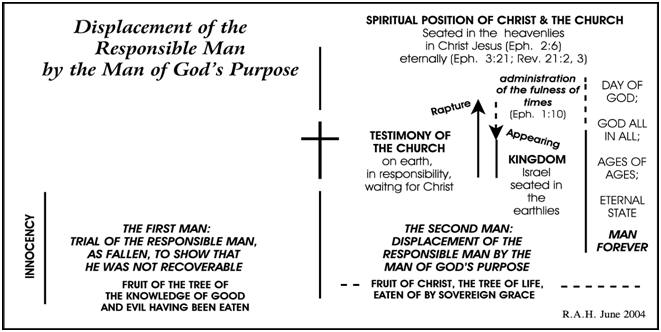
Pauline dispensationalist Roy A. Huebner elaborates:
“Natural man remains responsible to God—but the probation (testing) is over, the
first man (Adam) is judged in the Cross, the verdict based on the probation is
rendered, and the second man (Christ) is established before God, having
displaced the first man.
The first
man represents “the responsible man” and the second man is “the man of (God’s)
purpose.” Because “the responsible
man” was proved incorrigible and irremediably lost, and since the Cross he has
been declared to be so, it does not follow that individual natural men have no
responsibility to God.
They will
indeed be answerable at the great white throne judgment according to their works
(Rev. 20).
However, the era of testing ended
at the Cross and there are no ages of testing thereafter.”[6]
“For the law was given through Moses, but grace and truth came about through Jesus Christ (John 1:17).” The time of testing by Law, as well as by grace and truth are past.
“The first man (Adam), in the persons of the Jews to whom He was presented, was
tested by Him who was personally full of grace and truth.”
“The Cross was the end of man being tested by grace and truth.
There is no ‘age of grace’ wherein man is being tested by grace.”
“The notion really implies that the previous testing was not enough!
It implies that the Son, full of grace and truth, was not enough to
complete the testing of the first man.”
In his classic comments on grace, W. R. Newell absolutely dispelled the notion that the nature of grace today involves testing in any form whatsoever. Further, he wrote:
"It is a humanly incurable delusion of the human heart that salvation is within the natural reach; and that at any time if a man will 'make up his mind like a man', and 'hold out to the end', God will certainly accept him. But this conception leaves out entirely the word 'mercy'. The very name of this plan is Vain Confidence. It has doomed and damned its millions. For, salvation being altogether of God, the soul who is hugging the delusion that it is 'of him that wills', 'of him the runs', is making God a liar and walking in blind pride."
The responsibility of those “in Christ” remains one of volitional participation in God’s drama of redemption. No hyper-Calvinist or Keswick-style passivity is allowed. “The righteous will live by faith” (Gal. 3:11). “…work out your salvation (through belief in and obedience to truth) with fear and trembling, for it is God who works in you…” (Phil. 2:12, 13). Romans 6:15-23 clearly establishes the fact that sanctification is the progressive exchange of bondage to sin for bondage to righteousness. Further, to suggest autonomy before conversion but not after, or after while not before; neither theory squares with Scripture.
Why This Article Was Written
From time-to-time, withChrist.org receives emails from individuals who detect a quintessential difference between the views of Miles Stanford and those of expressed by Middletown Bible Church and George Zeller. For example, MBC and Zeller's ambiguity on the doctrine of election (and they are by no means alone or unique) was and continues to be disconcerting for correspondents who are trying to understand and navigate today's theological minefields. They sense the difference, can't put their finger on the issue(s), and subsequently ask for clarification.
At this late date, Mr. Zeller doesn't feel the need to deal with the issues I've raised in this article, nor reconcile his selective perception of Miles with what Miles Stanford actually wrote. In his interactions with me, his single-minded objective appears to be that of soliciting endorsements to further his own ministry and doctrinal agenda. To that end, he believes the critical differences raised in this paper should be obfuscated and avoided.
He has repeatedly called to my attention the fact that he and Middletown Bible Church have, from time-to-time, ordered and distributed select publications of Miles Stanford. For him, the decision to promote and share The Green Letters (very first work written 1960-63 of which was largely based on study of Keswick and devotional Plymouth Brethren writers) offsets the significance of any doctrinal differences. However with Miles Stanford's later published ministry he wrote, "There are contemporary leaders who would seek to attach the identification truths to their error-ridden ministries, without forsaking their aberrations." He further suggests that Miles' decision to ignore differences was indicative of agreement as well as endorsement of MBC and his writings, rather than patience and long suffering by one whose "ministry was helpful" to him in "many ways." In response to George Zeller's 'brotherly' protests and chronic misunderstandings, this ministry will continue to emphasize the need for, "Clarity, not agreement."
[1] Miles Stanford wrote:
“The Calvinist rightly
believes that God elects those whom He of His own free will and divine
purpose foreordained from the foundation of the world.
God’s
choice is on the basis of pure grace, wholly apart from any form of
human merit or works. Nothing
can be foreknown with certainty
without first being foreordained.”
Covenant Calvinism --
Moses-Centered
[2]
Miles Stanford wrote:
“My Father, in eternity
past, formed me positionally as an individual in His mind.
“Humanism can be
clearly seen in the Arminian's "election."
He claims that God chooses, or
elects, those whom He foreknows will of their own volition, choose His
Son. Hence the sinner's
free-will choice of the Saviour, not God's eternal choice of the sinner,
is the basis of the charismatic's election.
“The dependent believer acknowledges that the Father is the sole source of his election, and not his own will. According as He hath chosen us in Him before the foundation of the world, that we should be holy and without blame before Him, in love having predestinated us unto the adoption of sons by Jesus Christ to Himself, according to the good pleasure of His will (Eph. 1:4,5).”
[3]
The late Pauline dispensationalist
Roy Huebner published his excellent
God’s Sovereignty and Glory in
the Election and Salvation of Lost Men in 2003.
Like Darby before him, he does a particularly fine job in
treating the subject of responsibility, and the problems of confounding
responsibility with power (ability) or grace.
His 300-page book is a particularly effective refutation of all
those who claim to be so-called “moderate Calvinists”
similar to
Norman Geisler (and others) in his book, Chosen But Free.
[4] Regarding the fallacious logic that responsibility implies power (ability) and that man is being tested and judged by Christ as to whether they will believe, John Darby wrote:
“The history of man in
responsibility goes on up to the Cross; but, since the Cross, a man,
though individually he goes through the discovery of what he is, is not
in a state of probation [i.e. testing, as he was under Law] at all;
responsibility in that sense is over.
“Thus since the Cross
man’s responsibility, as such, is over; it is not that he has not debts
or sins, or that he was not responsible: all that is true, but God was
rejected finally, and God comes and works His own work all alone by
Himself.
“The Cross met our responsibility; there the first man, whether Gentile or Jew, came to the last pitch of wickedness. This closed all the history of responsibility.
[5] Roy A. Huebner, Dispensational Truth, Volume 1, New Jersey: Present Truth Publishers, pp. 131-143, 1996, 1998. Sadly, this first effort to establish a systematic theology for Pauline dispensationalism was published three years before Miles Stanford’s death. Readers should be aware that Huebner’s ecclesiological writings adhered rigidly to the excesses promulgated by the “closed” Plymouth Brethren.
Also see, Common Grace: Myth vs. Reality.
 Mail this article to a friend
- SEATED
- ASCENDED
- RAISED
- BURIED
- CRUCIFIED